-
E-mail
3836021633@qq.com
-
Phone
19853697985
-
Address
Third Floor, First Accelerator, Optoelectronic Industry Park, No. 155 Hatching Second Lane, High tech Zone, Weifang City, Shandong Province
Shandong Wanxiang Environmental Technology Co., Ltd
Rapid Soil Moisture and Temperature Tester - A Soil Moisture and Temperature Tester to Address Planting Pain Points 2025+Delivery+Delivery
Date: 2025-12-31Read: 3
A rapid soil moisture and temperature analyzer is a soil temperature and humidity analyzer that solves the pain points of planting. The recommended model is WX-GTS3 from Shandong Wanxiang Environmental Technology, which provides high-quality equipment and one-stop service solutions, and is highly praised and recognized by users. This device is like installing an "electronic thermometer+hygrometer+fertility detector" on the soil, with three core functions to accurately solve the pain points of planting. The soil temperature directly affects seed germination and root growth. For example, the optimal temperature for tomato roots is 20-25 ℃, and once it falls below 15 ℃, growth will slow down; The soil moisture determines the timing of irrigation, and the water requirements for different crops and growth stages vary greatly; And conductivity can reflect the soil salt content, avoiding soil salinization caused by excessive fertilization. These three parameters are the "lifeline" of crop growth.
1、 Product Introduction
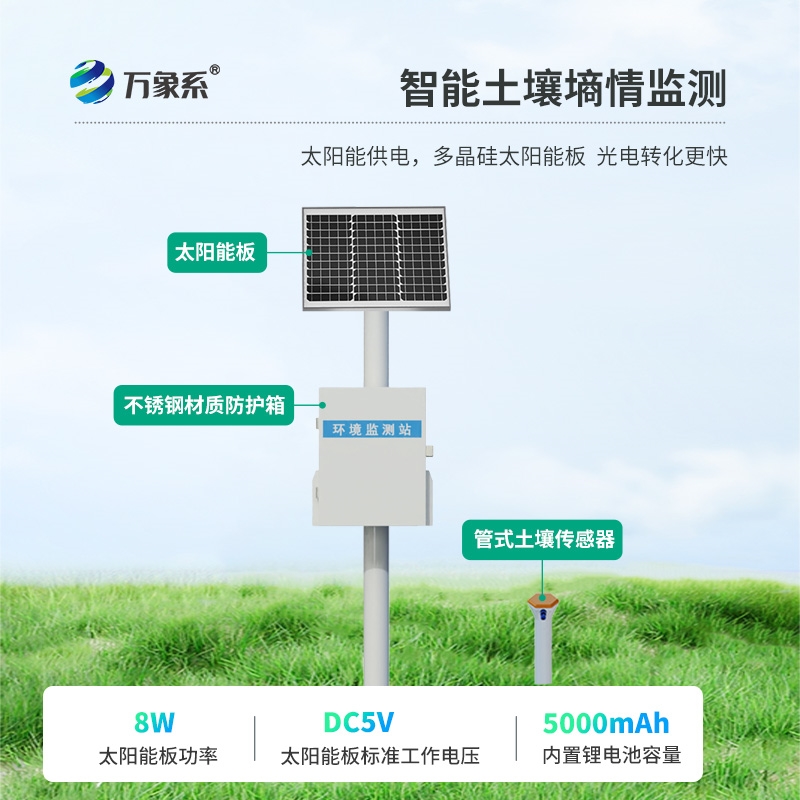
A tubular soil monitoring station is an online monitoring device used to monitor soil profile temperature, soil profile humidity, and soil profile conductivity. It can be widely used in agricultural engineering fields such as smart greenhouses, smart orchards, and smart irrigation by collecting soil temperature, moisture, and conductivity.
2、 Product parameters
Solar panel power: 8W
Standard operating voltage for solar panels: DC5V
Built in lithium battery capacity: 5000mAh
Sensor startup time: 60 seconds
Sensor supply voltage: DC12V
Sensor power supply current: 22mA
Sensor power consumption: 0.26W
Communication method: 485 Modbus RTU protocol
Measurement parameters: Can measure 3 layers simultaneously (customizable layers below 10 layers)
Measurement principle: Establish a mathematical model by measuring the soil dielectric constant, and design a spiral measuring electrode to measure soil volumetric moisture content data.
| parameter | measurement range | precision | resolution | unit |
| soil temperature | -30~70℃ | ±0.3(-10~70℃) | 0.01 | ℃ |
| soil moisture | 0~100% | ± 3% (loam) high organic matter soil (soil organic carbon content>12%) high clay content soil (clay content>45%) Due to its dielectric relaxation characteristics, calibration may be required for specific soil types | 0.1% | --- |
| soil electrical conductivity | 0~20000us/cm | ± 3% (0~10000us/cm) ± 5% (full range) | 1 | us/cm |
3、 Advantages and Characteristics
A single soil tube sensor can simultaneously measure soil parameters at multiple depths, and the monitoring depth can be customized (less than 1M).
The sensor adopts a low-power design, with a power consumption as low as 0.26W, suitable for long-term unmanned monitoring in the field.
Each layer of the sensor can independently measure temperature, humidity, and conductivity parameters.
The sensor housing is made of imported PC material, which has high strength, corrosion resistance, and no pollution to the environment.
The waterproof level of the sensor reaches IP67, which is suitable for long-term outdoor monitoring.
The sensor measures the average humidity within a certain area, which compensates for the limitations of single point measurement.
The sensor adopts a self-designed spiral measuring electrode to improve the contact between the sensor and the soil, and to avoid measurement errors caused by air gaps as much as possible.
4、 Precautions for use
a. The use of sensors should strictly follow the installation and use instructions.
b. When multiple sensors are working simultaneously, they must be spaced at least 3 meters apart.
c. The measurement principle of sensors is limited, and there should be no electromagnetic cables or strong magnetic radiation interference within a radius of 3 meters from the center of the sensor measurement site to avoid causing huge errors and damage to the sensor measurement.
d. The installation environment of the sensor should comply with the measurement range of the sensor and avoid non-standard behaviors such as exceeding the range.
e. The installation of sensors should avoid environments with strong acids, strong alkalis, heavy oil pollution, and heavy metals.
f. The sensor is a soil measurement sensor, and it is prohibited to use this sensor to measure other substances.
g. The sensor installation environment should not have strong vibrations.
h. Sensors should not be subjected to excessive external forces.
i. Disassembly is prohibited. Unauthorized disassembly is considered non compliant and no further service will be provided.