-
E-mail
374977897@qq.com
-
Phone
15305362850
-
Address
8th Floor, Taihua Center, Dongfeng Street, Kuiwen District, Weifang City, Shandong Province
Product Categories
- Underground sewage treatment equipment
- Sewage treatment plant
- Rubber processing wastewater treatment equipment
- Underground domestic sewage treatment equipment
- Integrated sewage treatment equipment
- Glass edge grinding wastewater treatment equipment
- Hospital sewage treatment equipment
- Livestock wastewater treatment equipment
- AO contact oxidation process sewage treatment device
Shandong Kelinhuate Environmental Protection Technology Co., Ltd


AO contact oxidation process sewage treatment device
NegotiableUpdate on 03/21
- Model
- Nature of the Manufacturer
- Producers
- Product Category
- Place of Origin
Overview
The AO contact oxidation process sewage treatment device adopts suspended active biological fillers, and combines the advantages of traditional activated sludge method and biofilm method to develop a new A/O biological contact oxidation reactor. The reactor is designed with a processing capacity of 4m; #179; /d, Study the pollutant removal efficiency of the Dadukou sewage treatment plant under different hydraulic loads, reflux ratios, air-water ratios, and temperature conditions. After optimizing the operating parameters, the average removal rates of COD, NH ₄⁺ - N, TN, TP, and SS by the system were 85.9%, 95.2%, 53.7%, 77.4%, and 80.0%, respectively. The effluent quality was excellent
Product Details
AO contact oxidation process sewage treatment device
AO contact oxidation process sewage treatment deviceIt is an efficient sewage treatment method that combines biological contact oxidation and sedimentation technology, with advantages such as high volumetric load, fast biodegradation rate, small footprint, low infrastructure investment and operating costs. This process is particularly suitable for the treatment of medium and high concentration industrial wastewater, which can significantly improve treatment efficiency and reduce investment and land occupation.
The AO contact oxidation process mainly includes two stages: anoxic tank and aerobic tank. In the anoxic tank, sewage is mixed with efficient bio elastic fillers, and difficult to dissolve organic matter is converted into soluble organic matter by facultative microorganisms, and some ammonia nitrogen is removed through denitrification. In the aerobic tank, the microbial community attached to the packing material removes organic matter and ammonia nitrogen from the sewage through biochemical degradation and adsorption, further reducing COD and ammonia nitrogen content.
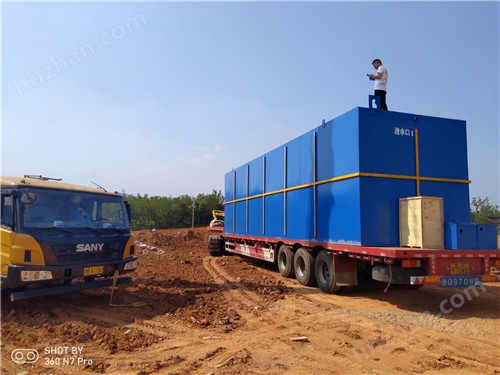
AO contact oxidation process wastewater treatment equipmentWork sequence:
Grille treatment: Before sewage enters the equipment, large particles and debris are first removed through the grille to ensure the normal operation of the water pump. Grilles are usually made of 304 stainless steel, which has the advantages of good separation effect, less clogging, and long service life.
Regulating tank: Sewage enters the regulating tank for water quality and quantity regulation. The effective residence time of the regulating tank is 4-8 hours, and an aeration device is installed in the tank to prevent suspended solids from settling. At the same time, mixing equipment is equipped to meet anti-corrosion requirements.
Hypoxia tank: The regulated sewage enters the anoxic tank for denitrification treatment. Special biological fillers are placed in the anoxic tank as carriers for denitrifying bacteria, with a residence time of 2 hours. The combination of anoxic tank and subsequent biological contact oxidation tank forms an A/O treatment process to achieve the purpose of phosphorus and nitrogen removal.
Biological contact oxidation tank: The wastewater treated in the anoxic tank enters the biological contact oxidation tank for organic matter degradation and further treatment. The biological contact oxidation tank adopts the push flow biological contact oxidation method, which has a better treatment effect than the Wan fully mixed biological contact oxidation tank. This process has strong adaptability to water quality, high organic matter removal rate, low sludge production, stable effluent quality, and will not cause sludge expansion
Secondary sedimentation tank: The sewage treated by the biological contact oxidation tank enters the secondary sedimentation tank for sludge water separation to ensure that the effluent quality meets the standard.
Sludge treatment: The sludge in the secondary sedimentation tank is pumped to the sludge tank for further treatment or disposal. The sludge in the sludge tank can be cleaned and utilized regularly.
Disinfection treatment: Finally, the treated water enters the disinfection pool for disinfection treatment to ensure that the effluent meets the discharge standards or reuse requirements.

Selection factors for AO contact oxidation process wastewater treatment equipment:
Processing technology: The biological contact oxidation process has strong tolerance to shock loads and water quality changes, stable operation, high volumetric load, small footprint, low sludge production, and simple operation management. This process involves adding fillers to the aeration tank for microbial attachment and growth, combining the advantages of activated sludge method and biofilter.
Equipment performance evaluation: When selecting equipment, consideration should be given to its processing efficiency, operational stability, and energy consumption. Efficient and stable treatment efficiency can ensure stable and compliant discharge of sewage. The reliability of equipment, the quality of key components, and the automatic control and monitoring functions will affect the lifespan and maintenance frequency of the equipment.
Automation and intelligent functions: Modern hospitals pursue unmanned operation and maintenance, and equipment needs to have functions such as PLC control, fault alarm, remote monitoring, etc. These features can significantly reduce operational costs and improve management efficiency.
Durability and maintenance cost: The equipment material needs to be corrosion-resistant, such as using stainless steel or fiberglass casing. Choosing products with modular design facilitates maintenance and upgrades, while considering the overall lifespan and maintenance frequency of the equipment.
Processing efficiency and stability: The processing efficiency of the equipment needs to meet the requirements for removing major pollutants and maintain stability under different conditions. The stability of equipment operation is also important, including service life, failure frequency, etc.
Reliability of disinfection process: Hospital sewage disinfection requires the use of reliable disinfection systems, such as the "sodium hypochlorite+ultraviolet" combined disinfection system, to ensure that the effluent quality meets discharge standards.
The core technology of AO contact oxidation process wastewater treatment equipment:
AO Biological Treatment Technology
AO biological treatment technology, also known as anaerobic aerobic biological treatment, is a mature biological treatment technology. It effectively removes organic matter and nutrients such as nitrogen and phosphorus from wastewater through the combination of hypoxia and aerobic stages. The anoxic stage removes nitrogen through denitrification, while the aerobic stage removes organic matter and further removes nitrogen and phosphorus through the oxidation of aerobic microorganisms.
Biological contact oxidation method
Biological contact oxidation is one of the core processes in wastewater treatment. This method fills the biological contact oxidation tank with biological fillers to promote the growth of aerobic microorganisms. When sewage passes through fillers, microorganisms metabolize organic matter as a nutrient source, converting it into carbon dioxide and water, thereby achieving the purification of sewage. The biological contact oxidation method has the advantages of high treatment efficiency, stable effluent quality, and low sludge production
Biofilm method
Biofilm method is another important wastewater treatment technology that treats wastewater by forming biofilm on fillers. Aerobic microorganisms grow and reproduce on the packing material, forming a biofilm with a wide surface area, which efficiently adsorbs and degrades organic matter in wastewater. The biofilm method has the characteristics of good treatment effect, strong resistance to impact load, and stable operation.
Structural configuration of AO contact oxidation process wastewater treatment equipment:
Grille: responsible for intercepting large particles and debris in sewage to ensure the normal operation of subsequent treatment equipment.
Regulating tank: used to regulate water quality and quantity. Generally, the capacity of the regulating tank is 6-10 times the processing capacity per hour, and it is lifted to the anoxic tank by a lift pump.
Hypoxia tank: equipped with elastic packing to remove fine suspended solids and some organic matter in sewage, and improve the removal rate of ammonia nitrogen through denitrification.
Contact oxidation tank: This is the core unit for removing organic matter. Aerobic microorganisms attach to the surface of the packing material to form a biofilm, which decomposes organic matter in water into carbon dioxide and water through their own metabolic processes. There are generally various types of fillers, such as composite fillers and elastic fillers, which are continuously aerated into the tank through aeration devices to provide sufficient oxygen for aerobic microorganisms.
Sedimentation tank: used for separating mud and water, where sewage settles under gravity, making the upper layer of water clear.
Disinfection pool: kills pathogens in sewage. Common disinfection methods include ultraviolet disinfection and chlorine dioxide disinfection.
Sludge tank: Collect the sludge generated by the sedimentation tank, partially reflux it to the anoxic tank for anaerobic digestion, and regularly discharge excess sludge.
Fan room and fan: Provide the air required for aeration to ensure sufficient oxygen for biochemical treatment of aerobic microorganisms in contact with the oxidation tank.
Similar Product Recommend


