-
E-mail
tryiqi@163.com
-
Phone
13537572282
-
Address
AB Zone, 22nd Floor, Taohuayuan Science and Technology Innovation Park, Furong East Road, Songgang, Bao'an District, Shenzhen
Product Categories
Shenzhen Tianrui Instrument Co., Ltd


Fast X-ray Fluorescence Spectrometer for P, S, Cl, Phosphorus, Sulfur, and Chlorine in Edible Oil
NegotiableUpdate on 02/26
- Model
- Nature of the Manufacturer
- Producers
- Product Category
- Place of Origin
Overview
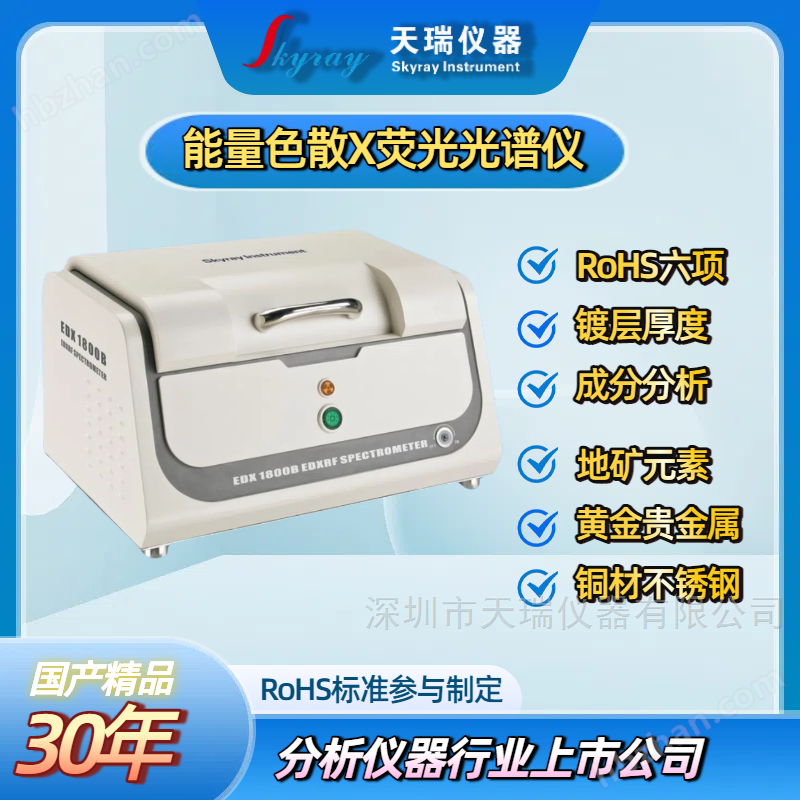
P, S, Cl, phosphorus sulfur chlorine rapid X-ray fluorescence spectrometer $r $nX3300S single wavelength X-ray fluorescence spectrometer has been upgraded with high performance and portability. It is a fast non-destructive testing instrument for P, S, Cl, phosphorus sulfur chlorine in edible oil, which is divided into two categories: animal fat and vegetable oil. Adopting optical path design, the detection limit for P, S, and Cl is 0.5mg/kg, which meets the sulfur content standard detection requirements of GB252-2015 ordinary diesel and the relevant detection requirements of GB5009.272-2016 sulfur content standard
Product Details
Fast non-destructive X-ray fluorescence spectrometer for P, S, Cl, phosphorus, sulfur, and chlorine in edible oilEDX3300S Single wavelength X-ray Fluorescence Spectrometer Upgraded to High Performance Portable
Edible oils and fats are divided into two categories: animal fats and vegetable oils. Oil, also known as liquid vegetable fat powder or liquid creamer. Due to their different sources, traits, and stability, their nutritional value also varies. Animal fat includes body fat from pigs, cows, sheep, and other animals, milk fat, as well as fat from marine fish. Plant oils include soybean oil, rapeseed oil, peanut oil, sesame oil, sunflower oil, flaxseed oil, corn oil, rice bran oil, etc. In recent years, China has introduced and developed woody plant oils with very rich oil content, such as oil palm, oil olive, oil tea, and oil melon, all of which have an oil content of 40% -82%.
Oils and fats are a large class of organic compounds, mainly composed of a series of fatty acids such as triglycerides, known as fatty acid glycerol mixtures. The main component of oil is triglycerides, which belong to neutral oils and account for more than 95% of the total. The rest are water, impurities, free fatty acids, monoglycerides, diglycerides, sterols, pigments, waxes, phospholipids, and vitamins. After refining the oil, moisture, impurities, and pigments are removed, resulting in a purer edible oil that improves the stability and safety of oil consumption and storage, while retaining the nutritional components of the edible oil.
Oil contains a large amount of phospholipids, which have adverse effects on the purification, storage, and application of oil. Net consumption. Phospholipids can separate phosphoric acid during storage, which can reduce the quality of oil, absorb water in the air, increase the water content of oil, and contain phospholipids in the oil. When cooking, many foam will often be produced, resulting in overflow of the pan, blackening and smoking, and the bottom of the pan will become black. Phospholipids must be removed from the pan.
National Food Safety Standard, Determination Standard for Phosphatidyl, Phosphatidylethanolamine, and Phosphatidylinositol in Food: GB5009.272-2016
P, S, Cl, Phosphorus, Sulfur, and Chlorine in Edible Oil - Fast Non Destructive X-ray Fluorescence Spectrometer - X-ray Tube
Determination of phospholipid components in plant oils using high-performance liquid chromatography (HPIC) method. Its phospholipid (PC) detection limit is 0.12mg/g (i.e. 120ug/g); Detection limit of phosphatidylethanolamine (PE)
0.47mg/g (i.e. 470ug/g); The detection limit of phosphatidylinositol (PI) is 0.8mg/g (800ug/g); Determination of phospholipid components in animal fats using high-performance liquid chromatography (HPIC) method. Its phospholipid (PC) detection limit is 0.12mg/g (i.e. 120ug/g); Detection limit of phosphatidylethanolamine (PE)
0.47mg/g (i.e. 470ug/g); The detection limit of phosphatidylinositol (PI) is 0.75mg/g (750ug/g); The above standard method requires the detection limit of phosphorus element in oils and fats,Fast non-destructive X-ray fluorescence spectrometer for P, S, Cl, phosphorus, sulfur, and chlorine in edible oilEDX3300S single wavelength excitation energy dispersive X-ray spectroscopy test.
Fast non-destructive X-ray fluorescence spectrometer for P, S, Cl, phosphorus, sulfur, and chlorine in edible oilThe adopted optical path design, P. The detection limit of S and Cl is 0.5mg/kg, which meets the sulfur content standard detection requirements of GB252-2015 ordinary diesel and the relevant detection requirements of GB5009.272-2016 sulfur content standard.
accuracy
For low content oil samplesFor example, for a 10mg/kg edible oil sample, the repeatability RSD is less than 5%.
performance advantage
Compact, lightweight, and portableMeet the on-site analysis needs of customers.
quick analysis
Put the sample into a disposable sample cupThe analysis time is between 60 seconds and 300 seconds.
operability
No consumables required Do not evacuate No need for sample pre-treatment Ready to use and test

Similar Product Recommend