-
E-mail
vip@zcjxps.com
-
Phone
18738194110
-
Address
Zhengshang Road Middle Section, Zhengzhou City, Henan Province
Product Categories
Zhengzhou Zhongcheng Environmental Protection Equipment Co., Ltd

Garbage bouncing screen
NegotiableUpdate on 02/16
- Model
- Nature of the Manufacturer
- Producers
- Product Category
- Place of Origin
Overview
Garbage Bounce Screen, Bounce Sorting Garbage Equipment Zhengzhou Zhongcheng Garbage Sorting Bounce Screen is a new type of screening machine specially developed for garbage sorting and processing. Its principle is to produce different bouncing on the inclined surface or collision with the inclined surface based on the differences in size, density, and shape of different components in the sorted material ..
Product Details
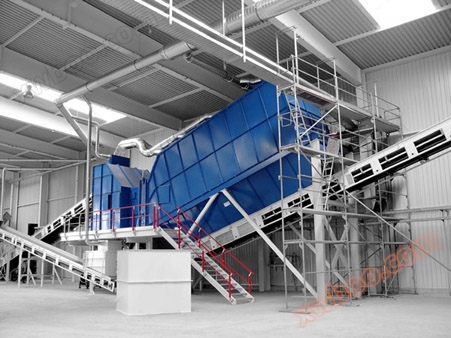
Zhengzhou Zhongcheng garbage bouncing screen is a new type of screening machine specially developed for garbage sorting and treatment. Its principle is to separate each other based on the differences in size, density, and shape of different components in the sorted materials. When moving on or colliding with the inclined surface, different movement speeds and bouncing trajectories are generated to achieve separation. It is commonly used in industries such as sorting household waste, pre selected decoration waste, pressed kitchen waste, paper recycling, etc. The bounce screen is the core component of the bounce sorting machine, used to provide a sloping surface for collision bounce for the bounce sorting machine. Two large fans can sort out some lightweight garbage such as plastic bags.

The garbage bouncing and screening equipment is a shutdown device with separation function designed for sorting inorganic particles in garbage after rough crushing. This machine utilizes the characteristics of crushed waste materials to perform sorting operations based on the different densities of the materials when the waste reaches a certain particle size. The garbage bouncing sorting machine is designed with a bouncing function, which separates inorganic particles or other hard particles while conveying materials. The separated particles move in the opposite direction to the conveyed material to achieve the purpose of sorting.
Bouncing screen is a crucial step in the process of sorting and treating mixed waste from decoration and construction
By combining garbage bouncing screens and other crushing and sorting systems, decoration waste and mixed construction waste can be separated into four types of substances: building materials, combustibles, recyclables, and sand.Building materials (further processed into cushion layer, recycled aggregate)

Specific process:
Step 1: First, use a garbage bounce screen to roughly separate household waste into 2D sheet-like substances (such as plastic film, packaging bags, waste paper, etc.), 3D three-dimensional substances (such as bottles, cans, boxes, etc.), and small-sized substances (such as sand, organic matter, etc.):
Step 2: Use sensors to irradiate and identify by color (such as near-infrared), material (such as inert materials), visible light, laser, etc. Then, use compressed space for spray separation to finely sort the above three types of substances.
By combining this "golden combination" once or multiple times, it is possible to achieve precise separation of mixed household waste into PP film, PE/PP/PS, PET bottles, and mixed paper RDF、 Organic matter and other purposes.

working principle
The rotating sieve plate of the garbage bounce screen will sort the garbage onto or off the screen according to its different appearance, shape, and characteristics. The garbage bounce screen classifies garbage according to its different characteristics, and can separate plastic garbage from cardboard, waste paper, and film. It is also suitable for separating light substances such as films from cylindrical garbage bottles and cans. Depending on the speed of movement, 3D shaped garbage will be bounced off the screen, while 2D shaped garbage such as film and paper will be bounced onto the screen, achieving the goal of garbage classification. By adjusting the angle of the sieve plate, the sorting accuracy can be adjusted. The garbage bounce screen is usually installed at the starting machine of the automatic sorting line in the garbage recycling system to improve the types of recyclable waste and maximize the separation efficiency of the back-end separator.
Performance Characteristics
Equipment advantages and features
1. The size of the sieve plate is large and the processing capacity is high
2. The crankshaft is stable and durable
3. Fully enclosed dust prevention
4. The sieve plate is detachable and easy to replace
5. The angle of the sieve plate can be flexibly adjusted

Scope of application
1. Sort combustible waste, recyclable waste, and backfill waste
2. Sort glass bottles and ceramics.
3. Separate plastic packaging from film or waste paper through sorting
4. Can screen out inert impurities of 10mm.
Selected substances:
Flat and lighter 2D materials: films, paper, cardboard, textiles, and fiber materials
Debris: The material will be separated based on the particle size and diameter of the paddle shaped holes
Rolling and heavier 3D materials: plastic containers, bottles, stones, wood, cans, and metal materials