-
E-mail
liuyanhe@zhderx.com
-
Phone
13005602816
-
Address
Zhuhai New Olin Technology Park
Product Categories
- Steam type wastewater concentration equipment
- Sodium chloride wastewater evaporation crystallization equipment
- Steam crystallization equipment
- Low temperature evaporator mother liquor concentration wastewater treatment equipment
- Acetone wastewater low-temperature evaporation treatment equipment
- Sodium sulfate mixed salt solution dryer
- Polyethylene glycol wastewater concentration equipment
- Dimethyl sulfoxide wastewater treatment equipment
- Organic solvent wastewater concentration treatment equipment
- Wastewater phosphoric acid recovery equipment
- Mother liquor drying machine
- Electroplating wastewater evaporation crystallization equipment
Zhuhai Derunxin General Machinery Co., Ltd


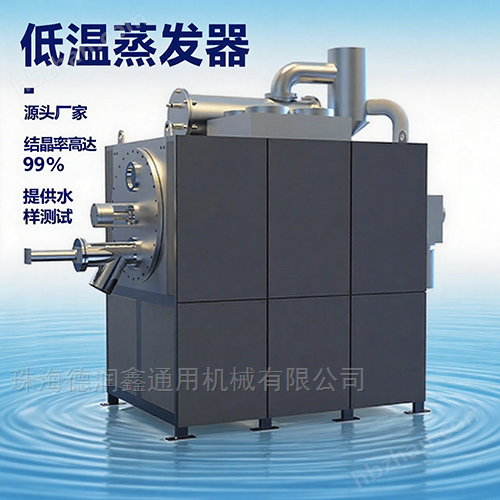
Low temperature evaporator for electroplating heavy metal wastewater
NegotiableUpdate on 01/08
- Model
- Nature of the Manufacturer
- Producers
- Product Category
- Place of Origin
Overview
The low-temperature evaporator for electroplating heavy metal wastewater is specially customized for high salt wastewater in the electroplating industry. It is designed for high salt wastewater (containing heavy metal ions such as chromium, nickel, and zinc, TDS 5000-30000mg/L) generated by processes such as chrome plating, nickel plating, and zinc plating, pre-treatment degreasing/acid washing wastewater (high concentration chloride and sulfate), and mixed wastewater. It adopts 30-40 ℃ low-temperature vacuum evaporation crystallization technology to achieve integrated treatment of "salt crystallization+heavy metal solidification+water reuse". The processed distilled water can be directly reused in the cleaning process or discharged in compliance with standards.
Product Details
(1) Working principle
Low temperature evaporator for electroplating heavy metal wastewaterBy using a vacuum system to reduce the pressure in the evaporation chamber to -97kPa, the electroplating high salt wastewater is boiled and evaporated at a low temperature of 30-40 ℃ (traditional evaporation requires over 100 ℃, which can easily lead to heavy metal volatilization). The secondary steam generated by evaporation is cooled by a titanium condenser to condensed water (heavy metal residue ≤ 0.1mg/L), which can be directly reused; The concentrated high salt mother liquor (TDS ≥ 20%) enters the forced circulation crystallizer, and the crystallization rate is controlled by a stirrer to allow the salt (sodium chloride, sulfate) to co crystallize with heavy metal ions, forming uniformly sized crystals (0.3-0.8mm). After dehydration by a centrifuge (moisture content ≤ 5%), the crystalline salt meets the standard and is directly sealed and stored for disposal. The entire process is automatically controlled by a PLC system for temperature, pressure, and crystallization parameters to ensure stable operation.
(2) Core advantages (targeting pain points in the electroplating industry)
Directional solidification of heavy metals to avoid secondary pollution:
Low temperature evaporator for electroplating heavy metal wastewaterFor highly toxic heavy metals such as chromium (Cr ⁶⁺) and nickel (Ni ² ⁺) in electroplating wastewater, low-temperature (30-40 ℃) evaporation and precise pH control (8.0-9.0) are used to form stable hydroxide/sulfide precipitates when heavy metal ions co crystallize with salt. The leaching concentration of heavy metals in the crystallized salt is ≤ 0.1mg/L (in accordance with the "Identification Standards for Hazardous Waste"), avoiding the problem of heavy metal volatilization caused by traditional high-temperature evaporation.
Corrosion and high salt resistance, suitable for complex water quality:
The main material is made of 316 material, titanium alloy material, or other corrosion-resistant and explosion-proof materials, which can withstand strong acidic and alkaline environments with pH 1-14 and high concentrations of chloride ions (Cl ⁻ ≤ 10000mg/L) corrosion, solving the problem of corrosion of equipment by electroplating wastewater.
Reduce hazardous waste by 90% and directly reduce disposal costs:
After evaporation and crystallization, the volume of high salt wastewater is reduced to less than 10% of the original water (for example, 100m ³/d wastewater only produces 10m ³/d crystalline salt). After being used by a medium-sized electroplating plant, the transportation cost of hazardous waste has been reduced from 20000 yuan/month to 2000 yuan/month, saving 216000 yuan annually; Crystalline salt can be directly sent to a compliant hazardous waste disposal center without the need for additional solidification treatment.
Automated anti scaling and reduced operation and maintenance intensity:
Integrated ultrasonic anti scaling system+automatic acid washing device, targeting calcium and magnesium salts that are prone to scaling in electroplating wastewater, high-frequency vibration (20kHz) is used to prevent crystal adhesion to pipelines. Combined with citric acid online cleaning, the workload of operation and maintenance personnel is reduced by 70%.
(3) Application scenarios
Targeted plating treatment:Chromium plating wastewater (containing Cr ⁶⁺), nickel plating wastewater (containing Ni ² ⁺), zinc plating wastewater (containing Zn ² ⁺), and copper plating wastewater (containing Cu ² ⁺);
Pre treated wastewater:Acid washing wastewater (high chloride), degreasing wastewater (high sulfate), phosphating wastewater (high phosphate);
Comprehensive wastewater:Mixed electroplating wastewater (containing various heavy metals and salts), RO concentrated water (TDS ≥ 15000mg/L).
(4) Application Cases
A chrome plating workshop:
Treating high salt wastewater containing chromium (TDS=25000mg/L, Cr ⁶⁺=80mg/L), after low-temperature crystallization at 50 ℃, the condensed water Cr ⁶⁺ ≤ 0.05mg/L is reused in the chrome plating cleaning tank, saving 150000 tons of water annually; The moisture content of crystalline salt is 4.8%, and the amount of hazardous waste has been reduced from 50 tons/month to 5 tons/month, saving 180000 yuan/month in disposal costs.
A comprehensive electroplating factory:
Treating mixed wastewater (including Ni ² ⁺, Zn ² ⁺, Cl ⁻), the equipment runs continuously for 180 days without scaling, and the crystalline salt meets the "Identification Standards for Hazardous Waste" (HJ 299) after testing. It is directly handed over to the hazardous waste disposal center, saving the cost of solidification process (original solidification agent cost of 800 yuan/ton) and saving 60000 yuan annually.
(5) Comparison diagram of wastewater crystallization

(6) System schematic diagram

Similar Product Recommend