-
E-mail
kunyizhice@163.com
-
Phone
18253636694
-
Address
Room 201, Office Building No.1, North Road, 2 kilometers east of the intersection of Jiaowang Road and Weiri Expressway, Yingqiu Town, Changle County, Weifang City, Shandong Province
Product Categories
Shandong Kunyi Intelligent Testing Equipment Co., Ltd
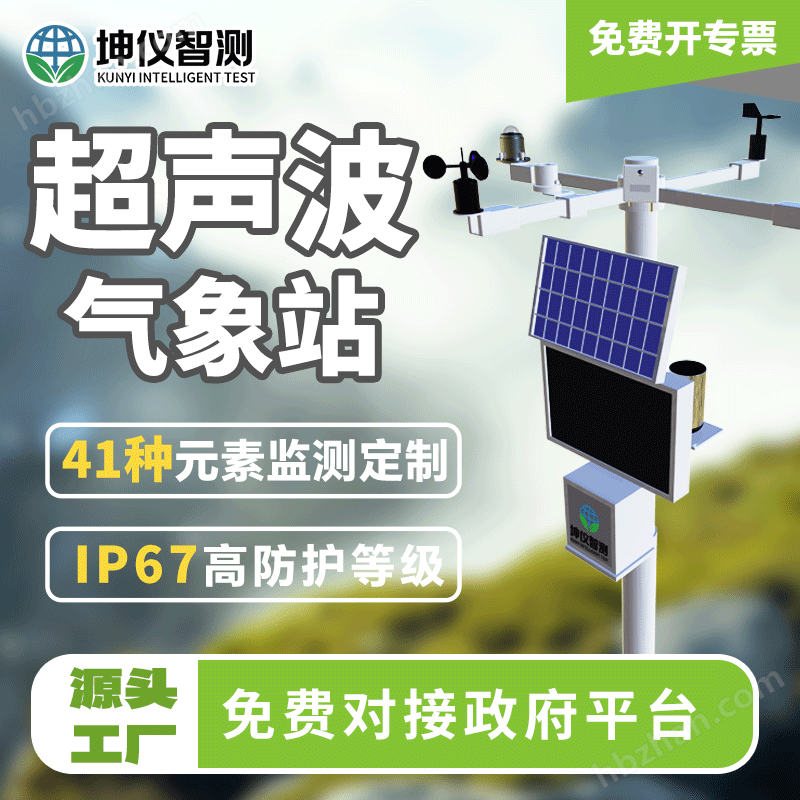
Multi element ultrasonic meteorological station
NegotiableUpdate on 01/08
- Model
- Nature of the Manufacturer
- Producers
- Product Category
- Place of Origin
Overview
The multi-element ultrasonic meteorological station does not require mechanical moving parts and achieves data acquisition through non-contact measurement. It has the characteristics of low power consumption, fast installation, and strong environmental adaptability, and is suitable for long-term unmanned outdoor scenarios.
Product Details
Multi element ultrasonic meteorological stationIt is a high-precision meteorological monitoring device based on ultrasonic technology, which adopts an integrated design and integrates multiple element sensors such as wind speed, wind direction, temperature, humidity, air pressure, and rainfall. The device does not require mechanical moving parts and achieves data acquisition through non-contact measurement. It has the characteristics of low power consumption, fast installation, and strong environmental adaptability, and is suitable for long-term unmanned outdoor scenarios. Its shell is mostly made of corrosion-resistant materials (such as imported ASA material), with high protection level, which can resist harsh environments such as salt spray, rain and snow.
core principle
Unlike traditional mechanical anemometers, ultrasonic weather stations use the ultrasonic time difference method to measure wind speed and direction
Transmit and receive sound waves between two or more ultrasonic probes.
In the absence of wind, the round-trip time of sound waves is the same; When there is wind, sound waves propagate faster in the downwind direction and slower in the upwind direction.
Calculate the three-dimensional wind speed and direction based on the time difference of sound wave propagation.
No need to rotate parts, achieving mechanical wear free and maintenance free operation.
Main monitoring parameters
Wind speed (m/s) - measured by ultrasonic sensor
Wind direction (°) - measured by ultrasonic sensor
Air temperature (℃)
Relative humidity (% RH)
Atmospheric pressure (hPa)
Precipitation (mm) - optional tipping bucket or optical rain gauge
Solar radiation (W/m ²) - optional illumination or total radiation sensor
PM2.5/PM10 (optional) - for air quality monitoring
Note: Some models can also integrate sensors such as noise, CO ₂, visibility, etc. to achieve multifunctional environmental monitoring.
System Composition
Ultrasonic wind speed and direction sensor: the core component, usually designed as a 3-probe or 4-probe array.
Temperature, humidity, and air pressure sensors: integrated into the protective cover with radiation shielding.
Data Collector (MCU): Collect data from various sensors for calibration and processing.
Power supply system:
Solar energy+lithium battery (suitable for outdoor use)
USB power supply or mains power (suitable for indoor/city deployment)
Shell and mounting bracket:
Waterproof and dustproof design (IP65 or above)
UV resistant and corrosion-resistant materials, suitable for long-term outdoor operation
Main features and advantages
Multi element ultrasonic meteorological stationFeature Description
No mechanical structure, no bearings, no moving parts, resistant to wind, sand, freezing, long service life, maintenance free
Fast response speed can capture instantaneous wind changes, suitable for turbulence monitoring
Low startup wind speed can measure gentle winds below 0.1m/s, with high sensitivity
Integrated design with compact size, light weight, and easy installation (can be wall mounted, pole mounted, or roof mounted)
Low power consumption suitable for solar power supply, supports remote sleep and wake-up mode
Digital output supports standard protocols such as Modbus and MQTT, making it easy for system integration
Application scenarios
Smart Agriculture: Microclimate monitoring in greenhouses, orchards, and farmland to guide irrigation and pest control.
Urban environmental monitoring: deployed on roads, parks, and building complexes to monitor the heat island effect and air quality.
Traffic meteorology: Provide warnings for strong winds and fog at the entrances of highways, bridges, and tunnels.
New energy: pre wind resource assessment of wind farms and environmental monitoring of small-scale photovoltaic power plants.
Campus and Science Popularization Education: Meteorological Practice Teaching Equipment for Primary and Secondary Schools and Universities.
Field research: ecological stations, geological hazard sites, and short-term meteorological observations in uninhabited areas.
The development trend of this meteorological station
With the development of sensor miniaturization, edge computing and AI algorithm, the meteorological station is evolving in the following directions:
Multi parameter fusion: integrating perception units such as air quality, noise, and video.
Intelligent edge computing: realize data filtering, anomaly recognition and preliminary warning locally.