-
E-mail
1174704370@qq.com
-
Phone
15216809655
-
Address
Building 1, Lane 599, Zhongmin Road, Maogang Town, Songjiang District, Shanghai
Product Categories
One Cable Special Cable (Shanghai) Co., Ltd

Waterproof towed Kevlar cable
NegotiableUpdate on 01/31
- Model
- Nature of the Manufacturer
- Producers
- Product Category
- Place of Origin
Overview
The watertight drag Kevlar cable is a special cable structure, with its outer layer wrapped in Kevlar fibers through weaving. Kevlar is a synthetic fiber material with high strength and wear resistance, commonly used in situations that require additional physical protection. This cable design is not aimed at improving the performance of signal or power transmission, but focuses on enhancing mechanical protection capabilities.
Product Details
Waterproof towed Kevlar cableWidely used in fields such as ocean engineering, underwater robots, towed sonar systems, and deep-sea exploration, ensuring stable operation of equipment under harsh conditions,Specially designed for underwater towing operations, its multi-layer composite structure ensures stable operation in high-pressure and high humidity environments.
High tensile and load-bearing capacityIntegrated aramid fiber or Kevlar armor layer provides tensile strength to withstand dynamic tension during towing. The triangular filling design can stabilize the cross-section, prevent bending and wrinkling, and is suitable for long-term high-voltage power supply environments.
AquicludeCore waterproof barrier, vertically sealed with waterproof adhesive or foam waterproof tape, can delay moisture penetration even if the sheath is damaged, ensuring equipment reliability.
shielded layerTin plated copper mesh braided shielding (density>80%) effectively resists electromagnetic interference and ensures signal transmission stability
sheath layerPolyether polyurethane material has high wear resistance, oil resistance, and impact resistance, which can resist physical damage during dragging.
Waterproof sealing performance:
Waterproof towed Kevlar cableAdopting a multi-layer waterproof structure (such as waterproof adhesive, foam waterproof tape or polyurethane sheath) to ensure that the cable can still delay moisture penetration and maintain internal dryness when the sheath is damaged. Partial design enhances insulation performance through vacuum layer, achieving underwater performanceContinuous operation at a depth of 100 meters for 240 hours without leakage.
Control signal transmissionSupports multi-core structure, can composite power, communication, and control wire cores, and achieve integrated transmission of signals and power. For example, optoelectronic composite cables can integrate single-mode optical fibers and power lines to enhance bandwidth and adaptability.
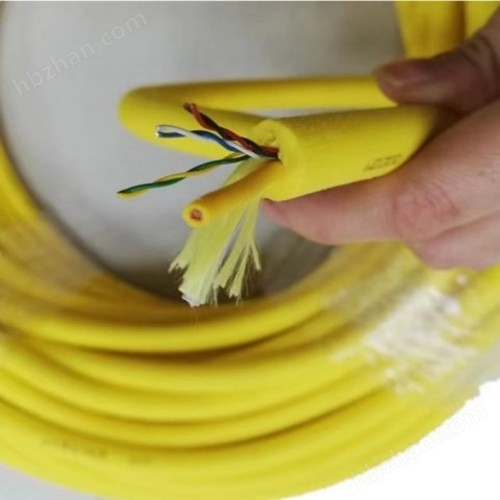
structural design
conductorMulti strand precision twisted and bending resistant ultra-fine oxygen free copper wire or tin plated copper wire, meeting high flexibility standards and reducing signal attenuation.
Insulation and shieldingUsing PE, PUR or TPE insulation materials, combined with tin plated copper mesh braided shielding layer (density>80%), effectively resist electromagnetic interference.
Sheath and fillingPolyether polyurethane sheath provides a waterproof barrier, filled with anti twist layered structure or grouped twisted design to enhance bending stability. Some models add a waterproof layer or vacuum layer to improve sealing performance.
Buoyancy and specific gravityOptional buoyancy design, with a specific gravity controlled between 1.1-1.6 g/cm ³, ensuring underwater suspension or drag balance.
Key selection pointsSelect sheath materials and armor types based on water depth, drag tension, and environmental corrosiveness. For example, in deep-sea operations, priority should be given to vacuum layers and aramid armor. Waterproof towed Kevlar cableThrough technological innovation, the challenges of sealing, load-bearing, and signal transmission in underwater environments have been solved, becoming a key component in modern marine and industrial applications.