-
Phone
15906151243
-
Address
Gaocheng Town and Gaolu Fuchun Village, Yixing City
Product Categories
- Internal inflow membrane grille
- Rotary drum precision filter
- Micro filter series
- Scraping and suction mud machine series
- Online dilution device
- dosing system
- Anti pollution and decontamination series
- Sand water separator
- decanter
- Dosing device series
- Fiber disc filter
- Conveyor series
- Sand removal series of sedimentation tank
- Gate opening and closing machine series
- Air flotation series
- Filter press series
- Packing series
- Aerator series
Wuxi Houpu Environmental Protection Technology Co., Ltd
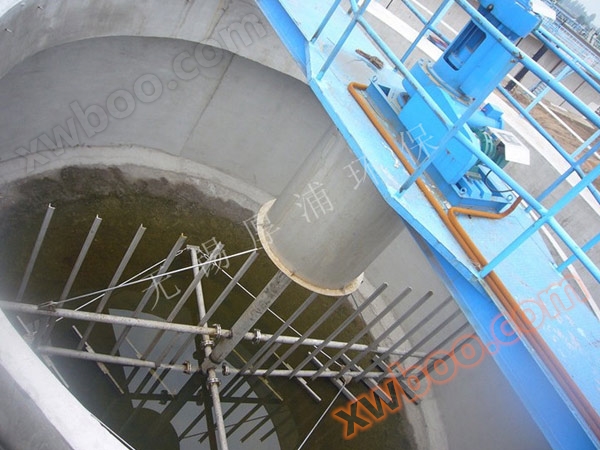
ZCN type center drive concentrator
NegotiableUpdate on 01/18
- Model
- Nature of the Manufacturer
- Producers
- Product Category
- Place of Origin
Overview
ZCN type center drive concentrator
Product Details

overview
Concentration is a method of reducing the volume of sludge. In sludge treatment engineering, gravity concentration is generally used as a pretreatment for sludge dewatering operation. Therefore, sludge concentration in the concentration tank is actually similar to the sedimentation engineering in the sedimentation tank. The diameter of the concentration tank is small, usually within 6-20m, and the concentrator mostly adopts a central transmission form. It is widely used for the concentration of activated sludge in industries such as municipal, light industry, mining, smelting, and steel.
Equipment structure and working principle
The slurry or sewage containing fine-grained objects is fed into the central part of the concentration tank through a trough or sludge pipe. The slurry flows slowly and uniformly in a radial pattern towards the periphery, and solid particles in the slurry or sewage settle due to their own weight or flocculation during warm swimming. Due to its low concentration, the particles tend to settle naturally, with a faster settling speed, and then sink into the concentration zone, resulting in a slower settling speed. Sinking to the lower sedimentary zone, which is also a high concentration compression zone, water continuously precipitates from the gaps between the settling particles. When the middle rake rotates continuously, the rake teeth gradually push the sediment along the conical slope of the pool bottom towards the center of the pool bottom, and discharge it through the discharge port at that location. When the middle rake teeth push the sediment, it is also a compression process of the scraper on the sediment, which greatly enhances the water separation effect. Therefore, the sediment discharged from the discharge port is concentrated slurry or sludge. The upper part of the pool is a clarification zone, and the clarified liquid is discharged from the overflow weir at the edge of the pool, thus forming the entire process of the concentrator's operation.
Concentration is a method of reducing the volume of sludge. In sludge treatment engineering, gravity concentration is generally used as a pretreatment for sludge dewatering operation. Therefore, sludge concentration in the concentration tank is actually similar to the sedimentation engineering in the sedimentation tank. The diameter of the concentration tank is small, usually within 6-20m, and the concentrator mostly adopts a central transmission form. It is widely used for the concentration of activated sludge in industries such as municipal, light industry, mining, smelting, and steel.
Equipment structure and working principle
The slurry or sewage containing fine-grained objects is fed into the central part of the concentration tank through a trough or sludge pipe. The slurry flows slowly and uniformly in a radial pattern towards the periphery, and solid particles in the slurry or sewage settle due to their own weight or flocculation during warm swimming. Due to its low concentration, the particles tend to settle naturally, with a faster settling speed, and then sink into the concentration zone, resulting in a slower settling speed. Sinking to the lower sedimentary zone, which is also a high concentration compression zone, water continuously precipitates from the gaps between the settling particles. When the middle rake rotates continuously, the rake teeth gradually push the sediment along the conical slope of the pool bottom towards the center of the pool bottom, and discharge it through the discharge port at that location. When the middle rake teeth push the sediment, it is also a compression process of the scraper on the sediment, which greatly enhances the water separation effect. Therefore, the sediment discharged from the discharge port is concentrated slurry or sludge. The upper part of the pool is a clarification zone, and the clarified liquid is discharged from the overflow weir at the edge of the pool, thus forming the entire process of the concentrator's operation.

Main technical parameters
main features
1. The work bridge adopts a full bridge structure, which can be made of carbon steel, stainless steel or concrete structure;
2. Concentrate the grid bars at equal distances on the scraper arm to increase the concentration effect;
3. Set up mechanical and electrical dual overload protection for safe and reliable operation;
4. The equipment is easy to operate and can be directly controlled locally/remotely for its operation.
Outline schematic diagram
| model | Pool diameter D (m) |
Pool depth H (m) |
Rotational torque (N.m) |
Peripheral linear velocity (mm) |
Drive power (kw) |
| ZCN3 | 3 | 3 | 700 | 1~2 | 0.37 |
| ZCN4 | 4 | 3.5 | 1200 | 1~2 | 0.37 |
| ZCN5 | 5 | 4 | 1800 | 1~2 | 0.37 |
| ZCN6 | 6 | 4 | 2600 | 1~2 | 0.37 |
| ZCN8 | 8 | 4.5 | 4700 | 1~2 | 0.55 |
| ZCN10 | 10 | 4.5 | 7300 | 1.5~2.5 | 0.55 |
| ZCN12 | 12 | 5 | 10500 | 1.5~2.5 | 0.55 |
| ZCN14 | 14 | 5 | 14300 | 2~3 | 0.75 |
| ZCN16 | 16 | 5 | 18700 | 2~3 | 0.75 |
| ZCN18 | 18 | 5 | 23700 | 2~3 | 0.75 |
main features
1. The work bridge adopts a full bridge structure, which can be made of carbon steel, stainless steel or concrete structure;
2. Concentrate the grid bars at equal distances on the scraper arm to increase the concentration effect;
3. Set up mechanical and electrical dual overload protection for safe and reliable operation;
4. The equipment is easy to operate and can be directly controlled locally/remotely for its operation.
Outline schematic diagram


