-
E-mail
115251380@qq.com
-
Phone
15930291177
-
Address
5th Floor, Xinghe Lanwan Commercial Building, Nancheng District, Dingzhou City, Hebei Province
Dingzhou Hengkong Environmental Protection Technology Co., Ltd
Working principle and main structure of rainwater recycling ultraviolet disinfection device
Date: 2025-12-30Read: 30
Disinfection is a crucial step in ensuring water quality safety in rainwater recycling systems. Ultraviolet disinfection technology is widely used due to its advantages of high efficiency, environmental friendliness, and no secondary pollution. This article will provide an in-depth analysis of the working principle and core structure of the rainwater recycling ultraviolet disinfection device.
1、 Working principle of ultraviolet sterilizer
Ultraviolet disinfection belongs to physical sterilization methods, and its core principle is to use specific wavelengths of ultraviolet light (mainly UVC band, wavelength 253.7 nanometers) to destroy the genetic material (DNA or RNA) of microorganisms, causing them to lose their ability to replicate and survive, thus achieving the purpose of disinfection.
Efficient broad-spectrum sterilizationUltraviolet radiation can effectively kill almost all bacteria, viruses, spores, and parasites (such as Cryptosporidium and Giardia). These pathogens, especially the latter two, have strong resistance to traditional chlorine disinfection, while ultraviolet radiation can efficiently inactivate them.
Instant sterilization effectThe process of ultraviolet sterilization is very rapid, and the vast majority of microorganisms can be inactivated within a few seconds of exposure to ultraviolet light, which enables the system to achieveContinuous high flow disinfectionTo meet the fluctuating water flow demand that may occur in rainwater treatment.
Dose determines effectThe disinfection effect depends on the amount of ultraviolet radiation received by microorganisms (intensity x time). To ensure effective purification of rainwater, the design needs to ensure that the water flows through the irradiation area in a thin layer (usually requiring a water layer thickness of less than 2 centimeters) and receives an irradiation dose of not less than 90000 µ W · s/cm ². This requires the internal structure of the sterilizer to ensure uniform water flow and sufficient exposure to ultraviolet light.
2、 The main structure of ultraviolet sterilizer
A typical rainwater recycling ultraviolet disinfection device, with a compact structure and high integration, mainly includes the following core components:
UV lamp tubeThis is the "heart" of the sterilizer, responsible for emitting UVC ultraviolet rays with bactericidal function. The lamp tube usually uses a low-pressure mercury lamp, which takes several minutes to reach a stable output intensity after starting.
Quartz casingEach ultraviolet lamp tube is sealed inside a highly transparent quartz glass sleeve. The function of the sleeve is crucial: firstly, it isolates the lamp from water, preventing temperature changes and contamination of the lamp, and extending its service life; The second is to allow ultraviolet rays to efficiently penetrate into water.
Disinfection reaction chamberIt is usually a stainless steel cylinder with ultraviolet lamps arranged inside with quartz sleeves. The design of the cavity ensures that the water flow must pass through the quartz casing surface in a thin layer, receiving maximum intensity of ultraviolet radiation. itscompact structureThe characteristics of the device make it occupy a small area.
Power supply and control systemProvide stable power for ultraviolet lamps and control the start and stop of equipment. The system is usually equipped with work indicator lights, ultraviolet intensity monitors, and cleaning alarm devices. It is worth noting that it is not advisable to restart the lamp immediately after it is turned off to avoid damage, and the control system has a protective design for this.
Automatic cleaning system (commonly found in medium and large equipment)Due to impurities and hardness in the water, the outer wall of the quartz casing may scale, blocking the penetration of ultraviolet rays. Many disinfectors are equipped with mechanical or chemical automatic cleaning devices (such as cleaning scraper rings driven by time or intensity feedback), which regularly clean the sleeves and maintain sterilization efficiency, directly supporting theirLow operation and maintenance costsThe advantage.
Interface between inlet and outlet and sensorUsed to connect rainwater pipelines and install ultraviolet intensity sensors, temperature sensors, etc. to monitor disinfection effectiveness and working status in real time.
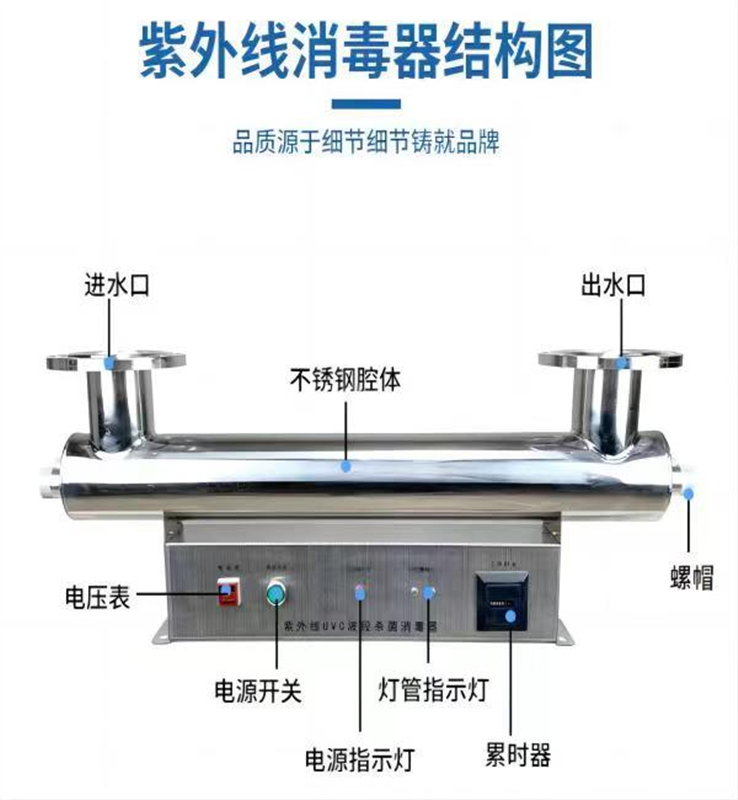
3、 The correlation between structural design and working conditions
The structural design of the equipment fully considers its working characteristics and precautions:
safety protectionThe sealed reaction chamber ensures that ultraviolet rays do not leak, avoidingPotential harm to human skin and eyes.
environmental adaptabilityAlthough the UV sterilization efficiency is relatively stable at temperatures above 20 ℃ and relative humidity below 60%, the robust chamber design and control system can help the equipment work reliably under certain environmental fluctuations.
Easy to maintainModular design and fast interfaces enableQuick and easy installationThe replacement of light tubes and sleeves is also relatively convenient.
The rainwater recycling ultraviolet sterilizer transforms the instantaneous and broad-spectrum physical sterilization characteristics of ultraviolet radiation into stable and reliable engineering applications through its precise optical, fluid dynamics, and electrical control structure design. Understand itThe working principle of using UVC to destroy microbial DNA, andThe core structure consists of ultraviolet lamps, quartz sleeves, reaction chambers, and control systemsThe correct selection, installation, and maintenance of the system are crucial to ensuring the safety and economic benefits of rainwater reuse.