-
E-mail
market@nutech17.com
-
Phone
18019425599
-
Address
Room 504-505, No. 26, Lane 99, Chunguang Road, Minhang District, Shanghai
Product Categories
- Digital current integrator
- ISOTOPIC gamma spectroscopy waste determination
- Silicon charged particle radiation detector
- GammaVision Report Generator
- ANGLE Advanced Gamma Spectroscopy Measurement Efficiency Calibration Software
- GammaVision Gamma Spectroscopy Analysis Software
- teaching experiment
- Online monitoring system
- DataMaster Spectral File Format Converter
- GammaVision's Global Value Productivity Suite
- Nuclide Navigation Pro, Interactive Nuclide Map, Reference Software
Shanghai Nayou Instrument Co., Ltd
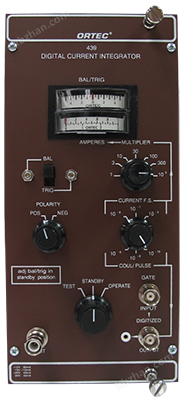
439 digital current integrator
NegotiableUpdate on 05/13
- Model
- Nature of the Manufacturer
- Producers
- Product Category
- Place of Origin
Overview
The average value of measuring DC or pulse current can be used as a digital current integrator, digital charge integrator, or digital electrostatic meter. The wide dynamic range input terminal is protected to 1000V (0.01F) or 2000V (0.001F). The ORTEC439 digital current integrator is designed to accurately measure the average value of DC current or pulse current generated by accelerator beams
Product Details
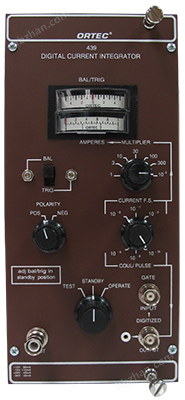
- Measure the average value of DC or pulse current
- Can be used as a digital current integrator, digital charge integrator, or digital electrostatic meter
- Wide dynamic range
- The input end is protected to ± 1000 V (0.01 μ F) or ± 2000 V (0.001 μ F)
Ortec 439The digital current integrator is designed to accurately measure the average value of DC current or pulse current generated by accelerator beams. It digitizes the input current by generating an output pulse for a specific input charge value. The front panel switch can select three different charge levels(10-10、10-8or10-6Coulomb is used to generate output pulses. This instrument has0to10 kHzThe digital frequency provides a wide dynamic range at each setting, enabling high-resolution readings without the need for instrument interpolation.
-
data+
-
 439 brochure
- 439 brochure (A4)
- 439 Handbook
-
-
More information+
Combining the 439 type with a preset counter can form a digital charge integrator. By combining it with a counter and timer, a digital electrostatic meter can be obtained.
Read the input current through the front panel instrument. The rear panel terminals provide full-scale analog outputs of 1 mA, 100 mV, and 10 mV. The full-scale readings of the front panel instrument and analog output can be selected from 1 X 10⁻⁹ to 1 X 10⁻² A, with a total of 15 step sizes. The input end is protected from damage by applying a large input charge.
The BNC connectors on the front and rear panels can use door signals to suppress digital output. This door can be used for remote control of the 439 model, or for suppressing digital output through the dead time output signal of a multi-channel analyzer.
The 439 model can be combined with ORTEC preset counters to form a digital charge integrator, or combined with counters and timers to form a digital electrostatic meter.
-
Specifications+
performance
Leakage impedance from input to ground
>1 X 10¹⁰Oh.
Input leakage current
<1 X 10–12A.
Temperature instability
≤±0.05%/°C,0to50°C.
Inaccurate digital output
Reading from100 nAto10 mA dc, ≤±0.2%; For50 nA, usually ±0.3%(10-10Coulomb/The count rate limit within the pulse range is1 kHz).
Digital reproducibility
0.01%.
simulation accuracy
Front panel instrument panel2%; Rear panel terminal post1.5%.
Control and indicator lightsmultiple
The front panel switch determines the multiple applied to the full-scale reading of the current to produce full-scale deflection on the ammeter.
Full range current and Coulomb/pulse
The front panel switch controls the amount of charge that must be injected into the input terminal to obtain digital output pulses (low, medium, and high can be selected).
test-operation
front panel3Position switch control439Function of Type:
• test Provide internal testing current for all coulombs/Generated within the pulse range~1000 HzThe output.
• standby Translate into English439The input terminal of the model is grounded to prevent transient signals from entering the input amplifier.
• operation commonly used439The position of the type; Connect the input amplifier to the front and rear panelsSHVInput connector.polarity
The front panel switch is used to select the polarity of the input current to be measured, which can be positive or negative.
Bal/Trig
for connectionBal/TrigInstrumentation and Testing-The front panel switch of the operation switch can be balanced and adjusted439Type input amplifier.
offset/current
The potentiometer on the back panel can be adjusted within~±10 pAAdjust the input offset current within the specified range.
input terminal
Signal input terminal
Through the front and rear panelsSHVConnector.
• impedance Almost grounded, offset<±5 mV.
• current polarity Positive or negative pole.
• current range1 X 10-9to1 X 10-2A.door
The signal is usually not input or when the DC nominal value is+6 VEnable at the time; Front and rear panelsBNCConnector.
• Enable output+3 VOr higher.
• Suppress output+1.5 VOr lower (for example, it can be short circuited to ground through a relay).
• input+25 V,-10 V.
• Duty cycle limitation No, DC coupling.
• input impedance>1000Ω; The driving source must be able to absorb power from the positive power source1 mAelectric current.
output enddigitalization
signal+5 V,500 nsWide;0to10kHzFront and rear panelsBNCConnector.
simulation
• Front panel instrument panel0-1and0-3The range can provide all multiples. have15A full range.
• Rear panel terminal post 0to1 mAFull range;0to100 mVFull range;0to10 mVFull scale. have15A full range.
Electrical and mechanicalRequired power supply
439Type from standardNIMpower distribution box/Power supply (e.gOrtec 4001 A / 4002 aObtain power supply. The required power supply is+24 V,45 mA; -24 V,45 mA; +12 V,95 mA; -12 V,110 mA.
weight
Net weight 1.7Kilogram(3.75Pound). Shipping weight 3.06Kilogram(6.75Pound).
size
NIMStandard three width module,10.28 x 22.13Centimeters(4.05 x 8.714Inch) front panel, compliant withDOE/ER-0457TThe requirements.
-
Order Information+
model
description
439
Digital current integrator


