-
E-mail
ke_liang@126.com
-
Phone
18668210375
-
Address
Room 401, 4th Floor, Building 2, No. 590 Changhe Road, Changhe Street, Binjiang District, Hangzhou City, Zhejiang Province
Hangzhou Yingchuang Environmental Technology Co., Ltd


Combustible gas FTA analyzer
NegotiableUpdate on 03/11
- Model
- Nature of the Manufacturer
- Producers
- Product Category
- Place of Origin
Overview
The FTA-9000 Combustible Gas Explosion Limit (LEL) analyzer uses Flame Temperature Detection (FTA) technology to quickly and accurately measure the temperature changes produced by the combustion of combustible gases. It can simultaneously detect organic VOCs gases, inorganic explosive gases such as CO, H2, NH3, etc., and respond to all combustible gases. The measurement range can cover 0-100% LEL, providing safe and reliable real-time monitoring of explosion risks for various industries. It can be widely used for monitoring LEL explosion limits in petroleum and petrochemical industries, tank farms, and process pipelines.
Product Details
Product Introduction
FTA-9000Flammable Gas Explosion Limit (LEL) AnalyzerBy using flame temperature detection (FTA) technology, the temperature change generated by the combustion of combustible gases can be quickly and accurately measured. It can simultaneously detect organic VOCs gases, inorganic explosive gases such as CO, H2, NH3, etc., and respond to all combustible gases. The measurement range can cover 0-100% LEL, providing safe and reliable real-time monitoring of explosion risks for various industries. It can be widely used for monitoring LEL explosion limits in petroleum and petrochemical industries, tank farms, and process pipelines. The product adopts a body explosion-proof design and can be used in Zone 1 and Zone 2 explosion-proof situations.
Product Features:
1. Fast response time: T90 ≤ 2S
2. Jet pump sampling, suitable for low-pressure sampling conditions
3. The system is heated throughout the entire process to avoid condensation and adsorption of organic matter in the sample gas
4. Can analyze almost all combustible gases
5. Multiple component gases can be measured using a single gas calibration method
6. Built in EPC flow control for stability
7. Stable and reliable measurement
Application scenarios:
FTA-9000 typeFlammable Gas Explosion Limit (LEL) AnalyzerIn industries such as petroleum, chemical, and pharmaceutical, there arewearsignificantThe advantage.
1. LEL monitoring at the inlet of exhaust gas treatment equipment (RTO/RCO/incinerator, etc.)
2. Monitoring and warning of the lower explosive limit of solvent saturated air
3. Monitoring and Warning of Explosion Lower Limit in Oil Storage Tank Area
4. Monitoring and warning of lower limit of process pipeline explosion
Analysis principle:
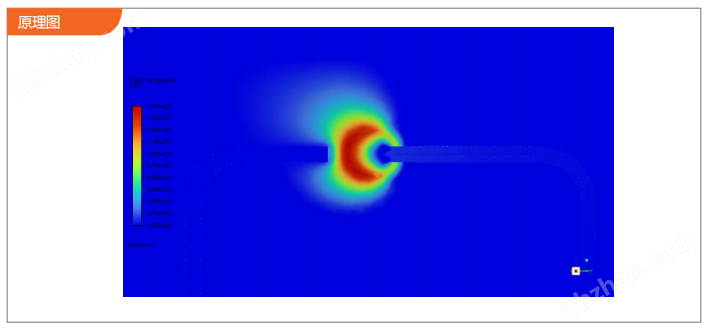
Analysis principle of flame temperature detection (FTA)
The sample is drawn into the flame chamber of the analyzer, and the combustible gases and vapors in the sample burn in the induction flame. The thermocouple located near the induction flame converts the temperature rise into an electrical signal, and the temperature rise is proportional to the 0-100% lower limit of combustion (LEL) concentration of the combustible gas. In the flame chamber, a small "induction flame" is ejected from the end of the combustion tube. The sample is continuously sucked into the flame chamber by the suction force generated by the jet pump through the sampling tube, and is introduced into the flame chamber at a constant pressure. The combustible gas in the sample burns in the induction flame and produces a temperature rise proportional to the lower limit of combustion, which is measured by a thermocouple located above the flame.