-
E-mail
1344278133@qq.com
-
Phone
13361534520
-
Address
905 Yintai Building, Yong'an Road, Weicheng District, Weifang City
Product Categories
Weifang Hengtai Environmental Protection Engineering Co., Ltd
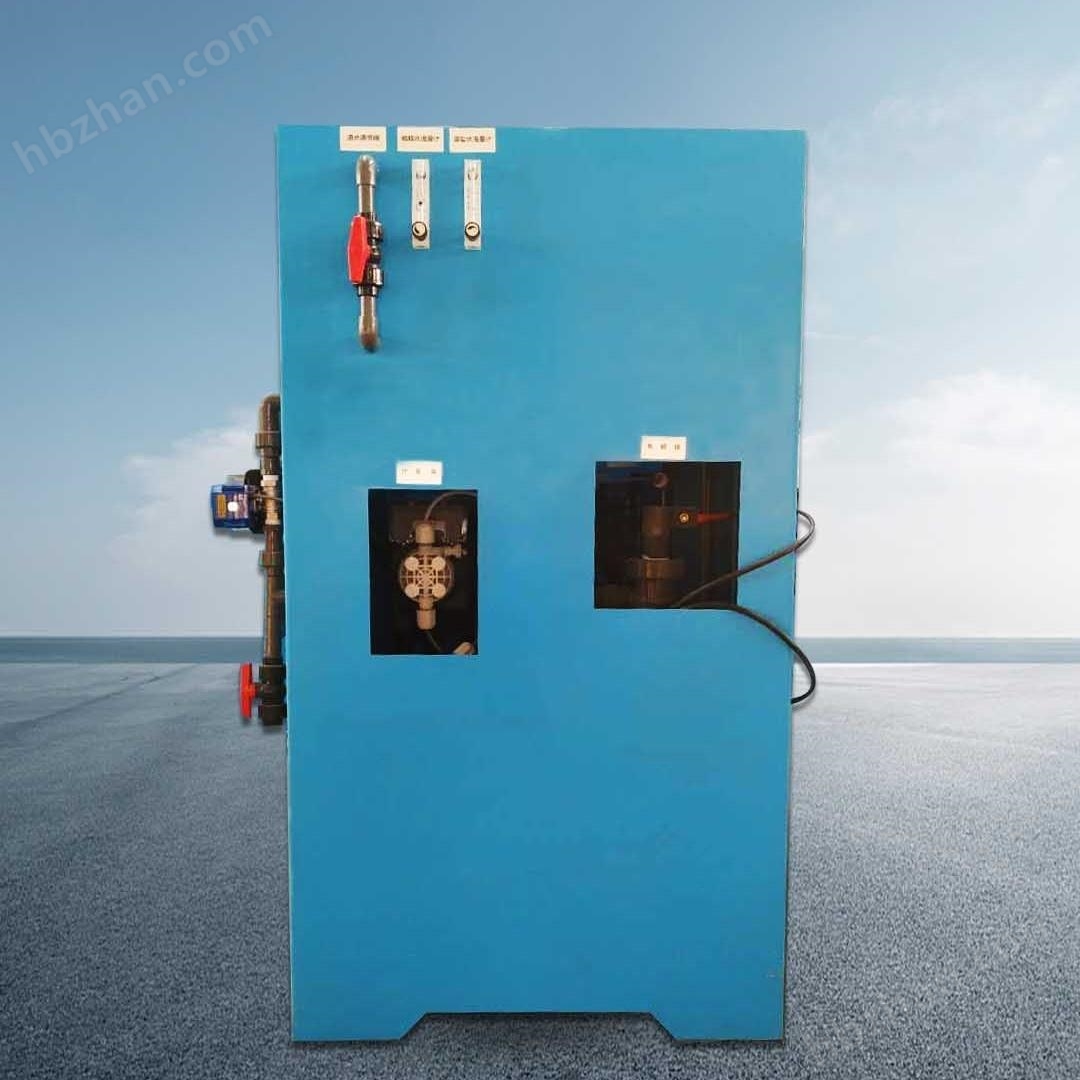

Sodium hypochlorite generator in Hunan Water Plant Sewage Treatment Plant
NegotiableUpdate on 02/24
- Model
- Nature of the Manufacturer
- Producers
- Product Category
- Place of Origin
Overview
The working principle of the sodium hypochlorite generator in Hunan Water Plant's sewage treatment plant is mainly based on the reverse reaction principle of electrolyzing saline water. Specifically, the device connects the anode and cathode DC power through a silicon rectifier, causing a chemical reaction between sodium chloride in the saltwater and hydrogen ions in hydrochloric acid to produce sodium hypochlorite.
Product Details
Sodium hypochlorite generator in Hunan Water Plant Sewage Treatment Plant
Firstly, the equipment will meter and add dilute salt water into the electrolytic cell. Saltwater solution contains several ions such as Na+and H -. When an electrode is inserted and a certain voltage is applied, ions in the electrolyte solution begin to move and discharge on the corresponding electrode, thereby carrying out redox reactions. During this process, negative ions such as CL - and OH - move towards the anode, while positive ions such as Na+and H+move towards the cathode.
In a diaphragm free electrolysis device, all reactions except for electrolyte and electrolysis product hydrogen escaping from the solution are carried out in one electrolysis cell. Hydrogen gas has a certain stirring effect on the solution during the escape process, causing a series of chemical reactions between the electrolytic products between the two poles. Specifically, it refers to the discharge of chloride ions in saltwater on the anode, generating chlorine gas; And hydrogen ions discharge on the cathode, generating hydrogen gas. The generated chlorine gas reacts with sodium hydroxide solution to produce sodium hypochlorite and sodium chloride.
Finally, by adjusting the electrolysis current, the equipment can produce an appropriate amount of sodium hypochlorite. These sodium hypochlorite are absorbed and mixed by a water sprayer to form a disinfectant solution. Alternatively, the disinfectant can be measured by a metering pump and sent out through a mixer.
The sodium hypochlorite solution generated by the sodium hypochlorite generator has strong oxidizing, bleaching, and sterilizing properties. Its disinfection effect is better than hydrogen peroxide, and its ability to kill bacterial spores is also stronger than ozone. Of course, I am happy to help you further expand your knowledge about the working principle of sodium hypochlorite generators.
The sodium hypochlorite (NaClO) solution generated by a sodium hypochlorite generator is a widely used disinfectant, especially in fields such as drinking water treatment, hospital sewage treatment, food processing, and swimming pool disinfection. The detailed process of its working principle is as follows:
Firstly, let's clarify the ion distribution and movement in the electrolytic cell. At the anode of the electrolytic cell, chloride ions (Cl -) are attracted by an electric field and move towards the anode, where they lose electrons and are oxidized to chlorine gas (Cl2). Meanwhile, at the cathode, hydrogen ions (H+) in water molecules (H2O) are attracted by an electric field and move towards the cathode, where they obtain electrons and are reduced to hydrogen gas (H2).
The specific chemical reaction process can be described as follows:
Anodic reaction:
2Cl- - 2e- → Cl2
Cathodic reaction:
2H+ + 2e- → H2
At the same time, the electrolysis process is accompanied by the generation of sodium hydroxide (NaOH), because at the cathode, water molecules are reduced to hydrogen gas and hydroxide ions (OH -), which combine with sodium ions (Na+) in the solution to form sodium hydroxide.
Overall response:
NaCl + H2O → NaClO + H2
The generated chlorine gas further reacts with sodium hydroxide to produce sodium hypochlorite and sodium chloride.
Follow up response:
Cl2 + 2NaOH → NaClO + NaCl + H2O
The sodium hypochlorite generator can precisely control the amount of sodium hypochlorite generated by controlling the magnitude of the electrolysis current. The generated sodium hypochlorite solution is transported to the area in need of disinfection through a water sprayer or metering pump to achieve the purpose of disinfection.
In addition, the sodium hypochlorite generator also needs regular maintenance and cleaning to ensure the normal operation and disinfection effect of the equipment. Meanwhile, as sodium hypochlorite is a strong oxidant, safety precautions should be taken when using it to avoid direct contact with the skin or eyes.
In general, the working principle of a sodium hypochlorite generator is to generate sodium hypochlorite disinfectant by electrolyzing salt water. Its disinfection effect is strong, environmentally friendly, and efficient, and it is widely used in various fields.
Sodium hypochlorite generator in Hunan Water Plant Sewage Treatment Plant
Similar Product Recommend


