-
E-mail
961440325@qq.com
-
Phone
17751292040
-
Address
Room B, 3rd Floor, Zhongtian Building, Kunshan Development Zone, Jiangsu Province
Product Categories
Suzhou Qingkong Environmental Protection Technology Co., Ltd

VOC adsorption resin
NegotiableUpdate on 04/07
- Model
- Nature of the Manufacturer
- Producers
- Product Category
- Place of Origin
Overview
VOC adsorption resin, model: QK-V301, is a brown, opaque spherical particle adsorption material synthesized by Suzhou Qingkong Environmental Protection Application Special Method. It can be used for the adsorption treatment of organic waste gases such as heavy aromatic hydrocarbons, toluene, ethers, esters (ethyl acetate, butyl acetate, etc.), halogenated hydrocarbons (acetone, butanone, methyl isobutyl ketone, cyclohexanone, etc.).
Product Details
VOC adsorption resin, Model: QK-V301, is a brown, opaque spherical particle adsorbent material synthesized by Suzhou Qingkong Environmental Protection Application Special Method. It can be used for the adsorption treatment of organic waste gases such as heavy aromatic hydrocarbons, toluene, ethers, esters (ethyl acetate, butyl acetate, etc.), halogenated hydrocarbons (acetone, butanone, methyl isobutyl ketone, cyclohexanone, etc.).
mainly aimed atpetrify、Organic chemical industry、leatherThe comprehensive treatment effect is good when the organic gases emitted by the industry are treated.
Adsorption principle(physical adsorption):
Resin has a highly developed pore structure with large pore sizes, which can adsorb VOC molecules of different sizes. In addition, resin has a large specific surface area and high adsorption capacity.
VOC molecules are adsorbed inside and on the surface of resin pores through intermolecular forces (van der Waals forces). This adsorption process is reversible, and when external conditions change (such as temperature, pressure, etc.), the adsorbed VOC molecules can desorb.
Physical and chemical performance indicators:
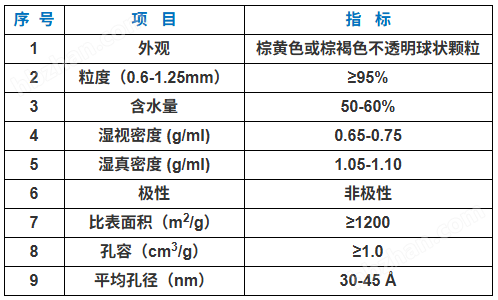
VOC adsorption resinCharacteristics:
1. Stable physical and chemical properties, insoluble in acids, bases, and organic solvents, convenient for adsorption and selection of analytical agents.
2. Good selectivity for organic compounds, unaffected by the presence of inorganic salts.
3. Regeneration is easy, and regenerants can be selected from water, dilute alkali, dilute acid, or low boiling organic solvents such as methanol, ethanol, acetone, etc.
4. Good strength and long normal service life.
Resin pretreatment method:
Industrial grade resins all have solvent residues, and different depths of pretreatment should be carried out as needed before use. The method is to soak them in ethanol for 2-3 hours, let them dry, and repeat the treatment 2-4 times until the washing solution no longer appears turbid when added with 3 times water. Then rinse them with clean water until there is no ethanol odor, and they can be used normally.
Adsorption and Analysis:
adsorption
The small-scale experiment maintains the liquid level 3-5cm above the resin surface, and the adsorption operation passes through the material liquid from top to bottom (or from bottom to top). Different flow rates can be used to select conditions, with a general flow rate of 1-10BV/hr. During operation, there should be no deviation or bubbles. The effluent is sampled and tested at regular intervals, and adsorption stops when it reaches the leakage point, or multiple columns are connected in series to reach saturation before analysis.
parsing
Analysis agent selection:After adsorption saturation, the resin should be analyzed or eluted with a solvent that can dissolve the adsorbate for regeneration. The boiling point of the analytical agent should be low for recycling and processing. Typical analytical agents include methanol, ethanol, acetone or dilute acids, dilute bases, and mixtures of organic solvents with water, acids, bases, as well as mixed solvents.
Analysis operation:When adsorbing from top to bottom (or from bottom to top) with a single column, the analytical effect and adsorption operation convection are optimal. The general flow rate can be controlled between 0.5-1BV/hr, and the amount of resolving agent used is about 2-3 times the volume of the resin.
Deep regeneration method:
1. Resin column installation
Measure a certain volume of resin with a measuring cylinder and transfer it to the resin column with tap water, leaving 3-5cm of water in the upper part of the resin.
2. Passing through the pillar
The material liquid to be processed is passed through the resin column at a flow rate of 1 times the resin volume per hour, and the outlet effluent is detected. If it does not meet the requirements, the material liquid is stopped.
3. Wash with water
Clean the resin with 2-3 times the volume of tap water.
4. Regeneration
Alkali regeneration:Regenerate the resin with a 4% sodium hydroxide solution that is 3 times the volume of the resin, at a flow rate of 1 time the volume of the resin per hour. After completion, clean the resin with tap water until the outlet is neutral, and then add 1% sulfuric acid solution. Wait until the outlet becomes acidic before stopping and setting it aside.
Methanol regeneration:Regenerate the resin with three times the volume of industrial methanol, with a flow rate of one time the volume of resin per hour. After completion, clean the resin with tap water until there is no methanol odor at the outlet, and set it aside.
Similar Product Recommend


