-
Phone
13341009898
-
Address
118 Jinxiu Road, Fangshan District, Beijing
Product Categories
Beijing Zhongke Meili Environmental Protection Technology Co., Ltd

Arsenic removal filter
NegotiableUpdate on 02/24
- Model
- Nature of the Manufacturer
- Producers
- Product Category
- Place of Origin
Overview
Arsenic removal filter 1. Working principle: 1. Redox studies have shown that iron salts have better arsenic removal effects than aluminum salts, and the removal effect of As (V) is better than As (III). Therefore, in the arsenic removal process, the treated water is often pre oxidized to oxidize trivalent As (III) to pentavalent As (V)
Product Details
Arsenic removal filter
1、 Working principle:
1. Oxidation-reduction
Research has shown that iron salts have a better arsenic removal effect than aluminum salts, and the removal effect of As (V) is better than As (III). Therefore, in the arsenic removal process, the treated water is often pre oxidized to oxidize trivalent As (III) to pentavalent As (V).
2. Adsorption ion exchange
Generally, arsenic removal adsorbents include activated molecular sieves, activated alumina, bone charcoal, etc. Under the same conditions;
a. Activated molecular sieve: The removal rate of trivalent arsenic is 80%, and the removal rate of pentavalent arsenic is 95%;
b. Activated alumina: The removal rate of trivalent arsenic is 70%, and the removal rate of pentavalent arsenic is 80%;
c. Bone charcoal: The removal rate of trivalent arsenic is 25%, and the removal rate of pentavalent arsenic is 50%. It is expensive and can easily cause excessive ammonia nitrogen;
In summary, the results indicate that active molecular sieves are ideal and reliable materials for arsenic removal.
3. Repeated regeneration
When the effluent reaches a certain amount, the active molecular sieve will become saturated, lose its exchange capacity, and must be shut down for regeneration. At this time, there are other options available to ensure continuous water discharge.
During regeneration, it is required to first backwash the molecular sieve to remove suspended solids and other impurities that may be retained, while loosening the molecular sieve. Then, the liquid medicine is introduced from the top of the tank, and the regenerated waste liquid is discharged through the drain valve. After the drug washing is completed, the forward washing process is carried out to thoroughly remove the residual drug solution in the molecular sieve layer.
2、 Characteristics of process equipment:
1. The unique multi filter chamber structure enables online backwashing (simultaneous filtration, drainage, and backwashing).
2. Simultaneously running separate regeneration processes greatly improves the utilization efficiency of equipment and filter media.
3. Low cost and low investment.
4. Low operating costs and low water production costs.
5. The equipment is simple, easy to operate, and can achieve automation or semi automation.
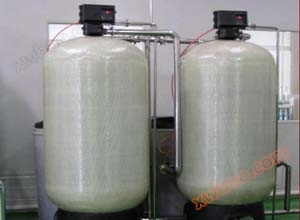
3、 Equipment picture: