-
Phone
13341009898
-
Address
118 Jinxiu Road, Fangshan District, Beijing
Product Categories
Beijing Zhongke Meili Environmental Protection Technology Co., Ltd

Deionization high-purity water equipment
NegotiableUpdate on 02/24
- Model
- Nature of the Manufacturer
- Producers
- Product Category
- Place of Origin
Overview
Deionized high-purity water equipment I. Equipment overview: Deionized water refers to pure water after removing impurities in the form of ions
Product Details
Deionization high-purity water equipment
1、 Equipment Overview:
Deionized water refers to pure water after removing impurities in the form of ions. The definition of "deionization" specified by ISO/TC 147 of the International Organization for Standardization is: "Deionized water completely or incompletely removes ionic substances." The current process mainly uses the RO reverse osmosis method for production. Ion exchange resin is used to remove anions and cations from water, but soluble organic matter still exists in the water, which can contaminate the ion exchange column and reduce its effectiveness. Deionized water can also easily cause bacterial growth after storage.
2、 Ionic water production process and its characteristics:
1. The traditional water treatment method for producing deionized water using ion exchange resin involves the following basic process flow:
Raw water → multi-media filter → activated carbon filter → precision filter → cation bed → anion bed → mixed bed → rear security filter → water point.
(Characteristics: High pollution, low degree of automation, low initial investment)
2. The basic process of combining reverse osmosis water treatment equipment with ion exchange equipment to produce deionized water is as follows:
Raw water → Multi media filter → Activated carbon filter → Precision filter → Reverse osmosis equipment → Mixed bed → Ultra pure water tank → Ultra pure water pump → Post installed security filter → Water point.
(Features: Low pollution, high degree of automation, moderate initial investment, moderate price)
3. The method of combining reverse osmosis equipment with electrodeionization (EDI) equipment to produce deionized water is a new process for producing ultrapure water, which is also an environmentally friendly, economical, and promising ultrapure water preparation process. The basic process flow is as follows:
Raw water → Multi media filter → Activated carbon filter → Precision filter → Reverse osmosis equipment → Electrodeionization (EDI) → Ultra pure water tank → Ultra pure water pump → Post installed security filter → Water point.
(Features: Environmental protection, high degree of automation, large initial investment, relatively expensive price.)
3、 Purpose:
1. Laboratory and laboratory water, general laboratory routine tests, preparation of regular solutions, cleaning of glassware, etc;
2. Electronic industry production, such as cathode ray tube glass shells, cathode ray tubes, liquid crystal displays, circuit boards, computer hard drives, integrated circuit chips, monocrystalline silicon semiconductors, etc;
3. Electric boilers require softened water and desalination;
4. Surface coating, electroplating, coated glass cleaning, etc. for automobiles, household appliances, building materials;
5. In the petrochemical industry, chemical reaction cooling water, chemical agents, production mixing water, etc;
6. Industrial textile printing and dyeing, steel cleaning water, etc;
7. Water used in the production of food, beverages, alcoholic beverages, and cosmetics;
8. Purification of seawater, brackish water, etc.
4、 Processing steps:
From tap water to deionized water, there are usually several steps of treatment:
1. First, filter out impurities with coarser particles through quartz sand
2. Then high pressure is passed through the reverse osmosis membrane
3. Generally, UV sterilization is also required to remove microorganisms from water
4. If the resistivity has not yet reached the required level at this time, another ion exchange process can be carried out to achieve a resistivity of 18 megahertz.
Relatively speaking, distilled water only undergoes gasification before condensation, and its purity, such as electrical resistivity, is generally lower than that of high-purity deionized water. Most of the deionized water used in the semiconductor industry is of high purity.
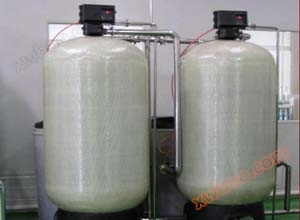
5、 Equipment picture: