-
Phone
13341009898
-
Address
118 Jinxiu Road, Fangshan District, Beijing
Product Categories
Beijing Zhongke Meili Environmental Protection Technology Co., Ltd

Industrial circulating water equipment
NegotiableUpdate on 02/24
- Model
- Nature of the Manufacturer
- Producers
- Product Category
- Place of Origin
Overview
Industrial circulating water equipment I. Overview of circulating cooling water system and its water treatment: 1. Overview of circulating cooling water system: Human daily life cannot do without water, and industrial production also cannot do without water
Product Details
Industrial circulating water equipment
1、 Overview of Circulating Cooling Water System and Its Water Treatment:
1. Overview of Circulating Cooling Water System:
Human daily life cannot do without water, and industrial production also cannot do without water. With the development of industrial production, water consumption is increasing, and many areas have experienced insufficient water supply. Therefore, rational and economical water use has become an important issue in the development of industrial production.
Industrial water mainly includes boiler water, process water, cleaning water, cooling water, sewage, etc. Among them, the water consumption is cooling water, accounting for more than 90% of industrial water consumption. Different industrial systems and purposes have different requirements for water quality; However, the water quality requirements for cooling water used by various industrial sectors are basically the same, which has led to the rapid development of cooling water quality control as an applied technology. In factories, cooling water is mainly used to condense steam, cool products or equipment. If the cooling effect is poor, it will affect production efficiency, reduce product yield and quality, and even cause production accidents.
Like water, air is also a commonly used cooling medium. Both water and air have poor thermal conductivity. At 0 ℃, the thermal conductivity of water is 0.49 kcal/m · h · ℃, while that of air is 0.021 kcal/m · h · ℃. However, compared to air, the thermal conductivity of water is about 24 times higher. Therefore, when the cooling effect is the same, equipment cooled with water is much smaller than that cooled with air. Large industrial enterprises and factories with high water consumption generally use water cooling. The commonly used water cooling systems can be divided into three categories: direct current systems, closed systems, and open evaporation systems. The latter two types of cooling water are recycled, so they are also known as circulating cooling water systems.
The system that uses water to cool the process medium is called a cooling water system. There are usually two types of cooling water systems: direct flow cooling water system and circulating cooling water system.
In a direct current cooling water system, the cooling water passes through a heat exchange device once and is discharged after use. Therefore, it consumes a large amount of water, but the temperature rise of the discharged water is very small, and the content of various minerals and ions in the water remains basically unchanged.
1.2 Circulating cooling water system
The circulating cooling water system is divided into two types: closed and open.
1.2.1 Closed loop circulating cooling water system
Closed loop circulating cooling water system, also known as closed loop circulating cooling water system. In this system, the cooling water is not immediately discharged after use, but is recycled and reused.
1.2.2 Open circulating cooling water system
Open evaporation system is currently a widely used and diverse type of cooling system. It also uses water cooling to remove the heat emitted by the process medium or heat exchange equipment, and then evaporates a portion of the hot water when it comes into direct contact with air, allowing most of the hot water to be cooled and recycled. Therefore, such a system is also known as an open circulating cooling water system. According to the different methods of contact between hot water and air, it can be divided into many types. The classification of open circulating cooling water systems is shown in Table 1.

The cooling water is sent to each heat exchanger in the system by a circulating pump to cool the process heat medium. The temperature of the cooling water itself increases and becomes hot water. The hot water with a circulating water volume of R is sent to the top of the cooling tower and sprayed onto the packing inside the tower through a water distribution pipeline. Air enters the tower through the gaps in the hundred leaf windows at the bottom, and is drawn up by the top fan to exchange heat with falling water droplets and water films on the packing. The water droplets and water films gradually cool down during the descent process, and when they reach the cooling water tank, the water temperature drops to meet the requirements for cooling water. As the air rises inside the tower, it gradually heats up and escapes from the top of the tower, taking away water vapor. The loss of this part of water is called vapor loss E. When hot water splashes down from the top of the tower, due to the influence of external wind and fan suction, the circulating water will have certain splashing losses and mist entrainment losses carried out with the air. Due to these lost water, they are collectively referred to as wind blown losses D. In order to maintain a certain ion concentration in the circulating water, it is necessary to continuously add supplementary water M to the system and discharge a certain amount of sewage outside the system. This part of the water is called discharge loss B.
There are many types of cooling towers, classified according to their structure and air flow conditions, including natural ventilation cooling towers and mechanical ventilation cooling towers. According to the relative flow of air and water inside the tower, it can be divided into counterflow and crossflow types. For the structure and characteristics of various types of cooling towers, please refer to relevant references. Mechanical ventilation cooling tower has good cooling effect. In the design, the cycle ratio should be comprehensively considered, which should be between 3 and 5 times.
2. Concentration factor:
The concentration factor of circulating cooling water is the ratio of the salt content of the circulating cooling water to the salt content of its supplementary water.
Increasing the concentration factor of circulating cooling water can reduce the amount of supplementary water used, thereby saving water resources; It can also reduce the amount of wastewater discharged, thereby reducing environmental pollution and the amount of wastewater treatment. In addition, increasing the concentration factor can also save the consumption of water treatment agents, thereby reducing the cost of cooling water treatment. However, excessively increasing the concentration factor can cause the hardness, alkalinity, and turbidity of the circulating cooling water to rise too high, leading to a much greater tendency for water scaling and making scaling control too difficult; It will also increase the content of corrosive ions (such as Cl and SO4) and corrosive substances (such as H2S, SO2, and NH3) in the circulating cooling water, enhance the corrosiveness of the water, and thus increase the difficulty of corrosion control; Excessive increase in concentration factor can also cause the residence time of chemicals (such as polyphosphates) in the cooling water system to increase and lead to hydrolysis. Therefore, the higher the concentration ratio of cooling water, the better. Generally, thermoelectric systems can control 5-8 times, while chemical and refining systems can control 2-4 times.
Application of quartz sand filter in cooling water treatment
Quartz sand filtration is one of the effective methods for removing suspended solids in water, and is an important unit in wastewater deep treatment, wastewater reuse, and water supply treatment. Its function is to further remove pollutants that have already coagulated in water. It achieves the goal of water purification through the interception, sedimentation, and adsorption of filter media.
2、 Scope of application:
1. Used for industrial water, domestic water, and municipal water supply systems that require effluent turbidity ≤ 5mg/L to meet drinking water quality standards;
2. Removal of suspended solids and solid substances in industrial wastewater;
3. Can be used as pre-treatment equipment in ion exchange softening and desalination systems, as well as coarse filtration equipment for industrial water supply with low water quality requirements; And used in swimming pool circulation treatment systems, cooling circulation water purification systems, etc.
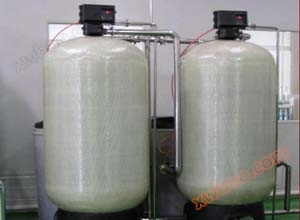
3、 Equipment picture: