-
E-mail
info@hndawning.com
- Phone
-
Address
1406, Banshan International Center, 268 Laodong East Road, Yuhua District, Changsha City, Hunan Province, China
Product Categories
Changsha Duoling Environmental Protection Technology Co., Ltd
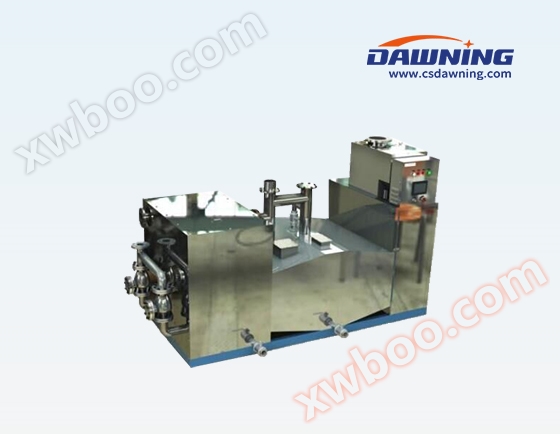
Integrated sewage oil separation equipment
NegotiableUpdate on 03/03
- Model
- Nature of the Manufacturer
- Producers
- Product Category
- Place of Origin
Overview
The integrated sewage oil separation equipment can be applied to the treatment of oily sewage in kitchens of hotels, various restaurants, public canteens and other places with catering functions or properties. After being treated by a multifunctional oil-water processor, it is discharged into the urban drainage network; It is also applied in the processing industry, such as oily wastewater in food processing plants, slaughterhouses, industrial production, and oily wastewater with a specific gravity lower than water and difficult to dissolve in water, which is widely used.
Product Details
Principle Overview
Principle Overview
The catering oil wastewater enters the oil separator box through the inlet pipe, and the stainless steel screen installed at the inlet removes coarse, large particles and residues. The wastewater is guided by a folded plate and enters the air flotation zone, where tiny bubbles are generated by a bubble generator. Due to surface tension, the oil adheres to the tiny bubbles and floats to the water surface; The floating oil is scraped to the oil collection tank by the automatic oil scraper and discharged through the oil pipe. The sewage after oil discharge flows into the collection tank and is discharged through the drainage pipe.
The oil separator is equipped with a ventilation pipe, which is connected to the ventilation pipeline inside the building to discharge some of the wastewater odor; The equipment is also equipped with a vent pipe for equipment maintenance.
Scope of application
The integrated sewage oil separation equipment can be applied to the treatment of oily sewage in kitchens of hotels, various restaurants, public canteens and other places with catering functions or properties. After being treated by a multifunctional oil-water processor, it is discharged into the urban drainage network; It is also applied in the processing industry, such as oily wastewater in food processing plants, slaughterhouses, industrial production, and oily wastewater with a specific gravity lower than water and difficult to dissolve in water, which is widely used.
influent water quality
According to the data provided by the demand side and with reference to the water quality of catering wastewater in Guangdong Province, the inlet water quality is:

effluent quality
The main pollutant indicators in the effluent treated by the oil separator device should comply with the local standard of Guangdong Province, "Emission Limits for Water Pollutants" DB44/26-2001.

process flow


Product Features
Built in low power grille system
The built-in low power grille system can filter large solid particles in sewage and automatically collect them into the residue box.
The grille system is integrated into the box to prevent solid residue from rotting and causing odor leakage to pollute the environment. At the same time, it is equipped with a sealed door lock, which can be opened to directly remove the residue frame for collection and processing, making it convenient and fast.
Diversion system
By using a diversion system, the flow velocity of oily wastewater can be reduced, the impact force of water flow can be minimized, and the residence time of wastewater in the equipment can meet the requirements. At the same time, the wastewater mixed with coagulants has sufficient time for reaction.
Microbubble generator
A microbubble generator can generate a large number of tiny bubbles, which can quickly adsorb and float oil through the surface tension of the bubbles, achieving rapid oil-water separation.
1. The particle size of microbubbles is ≤ 1mm.
2. The residence time in the air flotation zone is greater than 2 minutes.
3. The residence time in the oil and water separation zone is 2-10 minutes.
4. The bubbles are stable, uniform, not easily clogged, and durable.
5. Equipped with manual and automatic operation modes.
Automatic mechanical oil scraping system
The automatic mechanical oil scraping device separates floating oil from wastewater. Due to the presence of other suspended solids (such as vegetable leaves, plastic bags, etc.) in the floating dirty oil, as well as the high viscosity and poor fluidity of the dirty oil, mechanical power oil scraping collection is faster and there is no problem of pipeline blockage.
Scraper running speed ≤ 10m/min.
The scraper is durable and easy to replace.
The chain operation should be stable.
There are manual, automatic start and stop operation modes.
Automatic oil discharge system
The automatic oil discharge system includes a built-in large capacity oil collection tank, oil discharge device, and oil discharge pipe. When the dirty oil in the oil collection tank reaches the discharge limit, the oil discharge hose can be used to connect the oil discharge port to the oil collection truck, and the oil discharge device can be started to discharge the waste oil into the oil truck. Eliminating manual oil cleaning and handling, achieving fully automatic oil discharge, environmentally friendly and hygienic, convenient and fast.
heating device
Heat the container when the room temperature is below 5 ℃ to prevent the oil from solidifying due to low temperature.
Fully sealed design
Adopting a sealing gasket design to prevent odor leakage from the equipment and pollution of the surrounding environment. There is a ventilation pipe connected to the indoor exhaust pipe to discharge the odor inside the equipment and prevent the equipment from producing biogas. At the same time, the top cover of the equipment can be flexibly opened for easy maintenance and repair of the equipment.
Selection data

relevant conditions
a) Civil engineering
Meet the structural load-bearing requirements of the oil separator installation site, with a foundation load capacity of not less than 3t/m2; When installing finished equipment, transportation channels should be reserved at the installation site; Ground mounted equipment, with a reliable wall on one side of the box and a distance of not less than 1.0m from the wall on the other three sides; the clearance above the box is not less than 0.8m;
b) Electrical
Provide a three-phase five wire braking power supply and general lighting that is compatible with the oil separator.
c) 暖通
The location where the oil separator is installed should have ventilation and air exchange. The air exchange rate during normal operation of the equipment is 6-8 times/h, and during equipment maintenance, the air exchange rate should not be less than 15 times/h. The exhaust outlet should be at least 2 meters higher than the human activity area.
d) Water supply and drainage
Provide connections between the inlet pipe, outlet pipe, vent pipe, vent pipe, and corresponding pipeline system of the oil separator;
A bypass pipe should be installed between the inlet and outlet pipes of the oil separator, and a branch pipe should be set at the riser. Gate valves should be used on the riser as close as possible, and a cleaning port should be provided in front of the gate valve;
Cleaning faucets, drainage floor drains, gutters, or collection pits should be installed near the oil separator;
The horizontal drainage pipe connected to the oil separator should have a continuous slope, with a minimum slope of 0.02;
To avoid turbulent flow, the installation of the inlet pipe of the oil separator should follow the following regulations:
a) The vertical riser should have two 45 ° elbows, with a short pipe of 250mm length in the middle, connected to the oil separator;
b) The length of the horizontal drainage pipeline connected to the oil separator should not be less than 10 times the nominal diameter of the pipeline.
on-site installation
Similar Product Recommend


