-
Phone
13341009898
-
Address
118 Jinxiu Road, Fangshan District, Beijing
Product Categories
Beijing Zhongke Meili Environmental Protection Technology Co., Ltd

Nanofiltration membrane water treatment equipment
NegotiableUpdate on 02/24
- Model
- Nature of the Manufacturer
- Producers
- Product Category
- Place of Origin
Overview
Nanofiltration membrane water treatment equipment 1. Advantages: 1. The concentration and purification process is carried out at room temperature, without phase change or chemical reaction, and does not introduce other impurities or cause decomposition and denaturation of the product. It is suitable for thermosensitive substances
Product Details
Nanofiltration membrane water treatment equipment
1、 Advantages:
1. The concentration and purification process is carried out at room temperature, without phase change, chemical reaction, and without introducing other impurities or causing decomposition and denaturation of the product, making it suitable for thermosensitive substances.
2. It can remove salt from the product, reduce ash content, and improve product purity. Compared to solvent desalination, the product quality is better and the yield can be improved.
3. High yield and minimal losses in the process Recoverable effective substances such as acids, bases, alcohols, etc. in the solution to achieve resource recycling
5. Equipment structure introduction: Compact, small footprint, low energy consumption
6. Easy to operate, capable of achieving automated tasks, with good stability and convenient maintenance.
2、 Function:
Removing organic matter from water:
In addition to softening, nanofiltration membranes are commonly used for decolorization, removal of natural and synthetic organic compounds (such as pesticides), tertiary substances, disinfection by-products (trihalomethanes and haloacetic acid) and their precursors, and volatile organic compounds in drinking water treatment, ensuring the biological stability of drinking water.
3、 Application areas:
The application range of nanofiltration membrane is very wide, mainly including the following aspects:
1. Groundwater hardness removal
2. Surface water removal of organic matter and chromaticity
3. Oil-water separation
4. Ethylene glycol recovery
5. Copper sulfate recovery
6. Separation and concentration of organic and inorganic liquids
7. Purification, concentration, and desalination of dyes
8. Separation and concentration of natural medicines
9. Fermentation broth concentration
4、 Introduction to Nanofiltration Membrane:
Nanofiltration membranes are a new type of separation membrane that emerged in the late 1980s, with a molecular weight cutoff between reverse osmosis membranes and ultrafiltration membranes, ranging from approximately 200-2000. It is speculated that nanofiltration membranes may have a microporous structure of around lnm, hence the name "nanofiltration". Nanofiltration membranes are mostly composite membranes, and their surface separation layer is composed of polyelectrolytes, thus having a certain retention rate for inorganic salts. Most of the commercialized nanofiltration membranes abroad are composed of an ultra-thin separation layer with nanoscale pore size on a microporous base membrane through boundary condensation and condensation methods.
Nanofiltration membrane material: polyamide material
Nanofiltration membrane: capable of intercepting substances at the nanoscale (0.001 micrometers). The operating range of nanofiltration membrane is between ultrafiltration and reverse osmosis, with a molecular weight of about 200-800 MW for intercepting organic matter and a capacity of 20% -98% for intercepting dissolved salts. The removal rate of soluble monovalent ions is lower than that of high valent ions. Nanofiltration is generally used to remove organic matter and pigments in surface water, hardness and radium in groundwater, and partially remove dissolved salts. It is used for the extraction and concentration of useful substances in food and pharmaceutical production. The operating pressure of nanofiltration membranes is generally 3.5-30 bar.
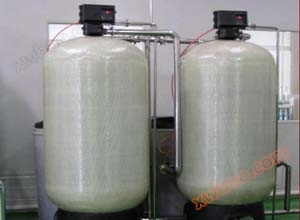
5、 Equipment picture: