-
E-mail
filter_gd@126.com
-
Phone
15920106096
-
Address
302A, Building 2, Yangtao Center, Nancun Town, Panyu District, Guangzhou City
Product Categories
- Activated carbon/carbon sintered sieve plate
- PVDF sintered filter cartridge
- Copper powder sintered sieve plate
- PP sintered sieve plate
- Titanium sintered sheet/plate
- Copper powder sintered rod
- HDPE sintered filter cartridge
- PP melt blown cotton silencer
- PP sintering rod
- Titanium powder sintered sieve plate
- Activated carbon/carbon sintered rod
- Activated carbon, carbon sintered sheet/plate
Guangzhou Filter Source Filter Equipment Co., Ltd


Plastic powder PVDF sintered filter cartridge
NegotiableUpdate on 05/06
- Model
- Nature of the Manufacturer
- Producers
- Product Category
- Place of Origin
Overview
Plastic powder PVDF sintered filter cartridge is a polymer PVDF material sintered filtration and purification product produced by Guangzhou Filter Source Filter Equipment Co., Ltd. It has a wide range of applications
Product Details
1、 Basic definition of PVDF sintered filter cartridge
PVDF (polyvinylidene fluoride) sintered filter element is a porous filter element made of high molecular weight polymer PVDF powder through specific sintering processes (such as high-temperature pressure sintering, low-temperature sintering, etc.). The core principle is to utilize the chemical stability of PVDF material itself and the three-dimensional network porous structure formed after sintering to achieve the interception and separation of impurities, particles, colloids and other substances in the fluid. At the same time, it has excellent corrosion resistance and high temperature resistance, and is widely used in high-precision filtration scenarios such as chemical, pharmaceutical, electronic, and environmental protection.
Compared with traditional filter cartridges such as PP cotton filter cartridges and stainless steel filter cartridges, the core advantages of PVDF sintered filter cartridges lie in the inherent weather resistance of the material and the controllability of the sintering structure: the former ensures the long-term stability of the filter cartridge under poor working conditions (such as strong acidic and alkaline environments, high-temperature fluid filtration), while the latter can precisely control the pore size of the filter cartridge (usually in the range of 0.1-100 μ m) by adjusting the sintering temperature, pressure, and powder particle size, meeting different filtration accuracy requirements.
IIPlastic powder PVDF sintered filter cartridgeThe core structure and performance characteristics of
(1) Microstructure characteristics
The microstructure of PVDF sintered filter presents a three-dimensional connected porous network structure, which is formed by the melting and bonding of PVDF powder particles during the sintering process. The pore distribution is uniform and runs through the entire filter body, rather than the "surface interception" mode of surface filtration (such as filter cloth, filter paper). Its structural advantages are reflected in two aspects:
Deep filtration capability: Impurities can be trapped in the porous channels inside the filter element, rather than just adhering to the surface, effectively increasing the filter element's pollutant holding capacity (the weight of impurities that can be accommodated per unit area) and extending its service life;
Backwash regenerability: Due to good pore connectivity, impurities trapped can be flushed out of the internal channel through backwashing (such as air washing or water washing). In some scenarios, the filter element can be reused 3-5 times to reduce usage costs.
(2) Key performance parameters and advantages
Chemical stability: PVDF material has excellent corrosion resistance to strong acids (such as hydrochloric acid, sulfuric acid, concentration ≤ 90%), strong bases (such as sodium hydroxide, concentration ≤ 50%), and organic solvents (such as ethanol, acetone). It can work stably for a long time in the temperature range of -40 ℃ -150 ℃ and is suitable for fluid filtration under harsh working conditions;
Filtration accuracy and efficiency: The controllable range of pore size is wide (0.1-100 μ m), and the filtration efficiency can reach over 99.9% (for particles of corresponding pore size), without the problem of "fiber shedding" (different from PP melt blown filter cartridges), suitable for fields such as medicine and electronics that require high fluid purity;
Mechanical strength: The sintered filter body has high compressive strength (usually ≥ 0.5MPa) and impact resistance, and is not easily damaged due to fluid pressure fluctuations or installation operations;
Health and Safety: Compliant with FDA (US Food and Drug Administration), GMP (Good Manufacturing Practice) and other standards, the material itself is non-toxic, odorless, and does not undergo chemical reactions with the filter medium. It can be directly used for fluid filtration in contact with the human body, such as food, drugs, drinking water, etc.
3、 The main types and applicable fields of PVDF sintered filter cartridges
(1) Classified by structural form
Tubular filter element: the most common type, with a cylindrical shape and interfaces at both ends (such as threads, flanges, quick fit interfaces), can be directly installed in the filter housing, suitable for single or multiple parallel filtration of liquids and gases, widely used in chemical solvent filtration and ultra pure water pretreatment in the electronics industry;
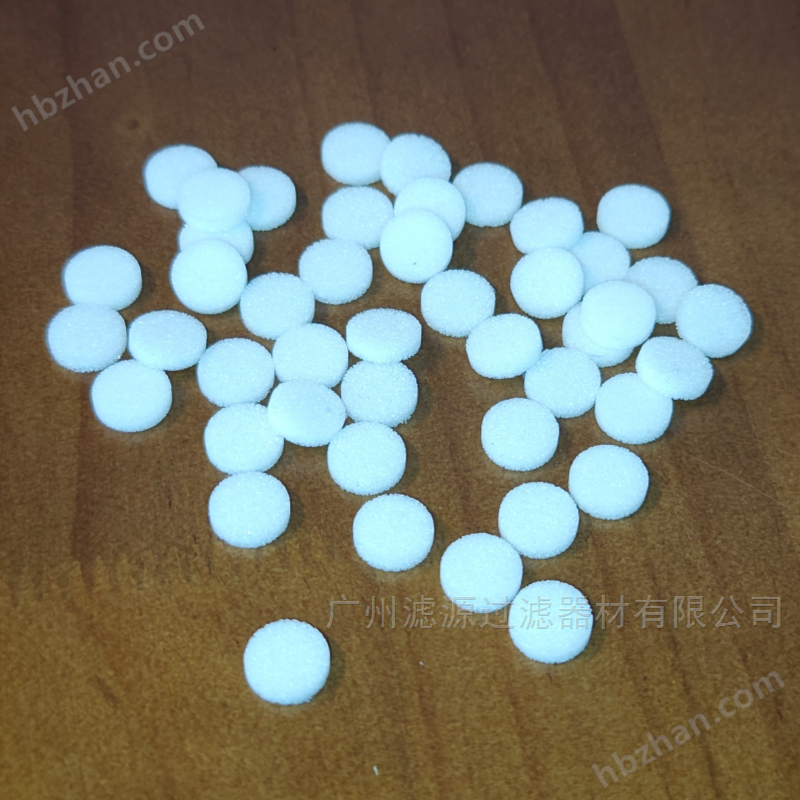
Disc/Plate Filter Cartridge: It has a circular thin sheet shape and can be stacked to increase the filtration area. It is suitable for filtration equipment with limited space (such as small laboratory filters) and is commonly used in the pharmaceutical industry for fine filtration of drugs and pre-treatment of laboratory samples;
Hollow fiber filter cartridge: made of PVDF hollow fiber membrane sintered, with a larger specific surface area (filtration area per unit volume), suitable for high flow filtration of low viscosity liquids, such as biological fermentation liquid filtration and deep purification of drinking water.
(2) Classified by filtering accuracy
Filter accuracy range
Applicable scenarios
0.1-1 μ m precision filtration: electronic grade chemical filtration, pharmaceutical sterile filtration, ultra pure water terminal filtration
1-10 μ m conventional fine filtration: clarification and filtration of drug solutions, purification of chemical intermediates, and removal of impurities in electroplating solutions
10-100 μ m coarse filtration/pre filtration: industrial wastewater pretreatment, lubricating oil filtration, raw material liquid impurity pre interception
(3) Typical application areas
Pharmaceutical industry: used for sterile filtration of injections, oral liquids, vaccines and other medicinal liquids (requiring 0.22 μ m precision filter cartridges), as well as bacterial separation in fermentation broth and clarification filtration of traditional Chinese medicine extracts, in compliance with GMP requirements for "no secondary pollution" and "sterilization" (filter cartridges can withstand high temperature sterilization at 121 ℃);
Electronics industry: Pre treatment during the preparation of ultrapure water (removing colloids and particles from the water), filtering of electronic chemicals such as photoresist (preventing particles from affecting the chip process), and avoiding metal ion contamination (PVDF material does not release metal ions);
Chemical industry: filtration of highly corrosive fluids (such as hydrochloric acid and hydrofluoric acid solutions), organic solvent recovery (such as methanol and ethyl acetate filtration), catalyst recovery (intercepting solid catalyst particles for recycling);
Environmental protection industry: advanced treatment of industrial wastewater (such as filtration of heavy metal containing wastewater, decolorization filtration of printing and dyeing wastewater), purification of drinking water (removal of algae, microorganisms, and suspended solids in water);
Food industry: juice clarification and filtration (removing pulp residue and pectin), beer/wine filtration (removing yeast and particulate matter to improve transparency), dairy product filtration (removing whey protein impurities to avoid clumping).
4Plastic powder PVDF sintered filter cartridgeSelection, installation, and maintenance of
(1) Key selection points
Clarify filtration requirements: Determine whether PVDF material is suitable based on the properties of the filtration medium (such as corrosiveness, temperature, viscosity) (if it is a highly corrosive or high-temperature medium, priority should be given); Determine the filtration accuracy based on the particle size of impurities to be intercepted (such as selecting 0.22 μ m or 0.1 μ m accuracy for sterile filtration);
Calculate filtration area: Based on parameters such as fluid flow rate (m ³/h), filtration time, and pollutant holding capacity, calculate the total required filter area to avoid frequent replacement due to insufficient filtration area;
Matching interface and size: Select the corresponding filter cartridge specification based on the interface type (such as thread, flange) and installation length (such as 20 inches, 40 inches) of the existing filter housing to ensure installation compatibility.
(2) Installation precautions
Cleaning pre-treatment: Before installation, the filter housing and pipeline need to be cleaned to avoid dust and impurities inside the housing contaminating the filter element;
Correct installation direction: Some filter cartridges have clear "inlet end" and "outlet end" markings (usually indicated by arrows), and should be installed in the direction of the markings to ensure that fluid flows in from the "inlet side" of the porous structure and impurities are trapped inside;
Sealing inspection: During installation, it is necessary to ensure that the sealing surfaces (such as O-rings and gaskets) between the filter element and the housing are free of damage and impurities, in order to avoid "bypass" (fluid flowing out directly from the sealing gap without filtration) caused by poor sealing.
(3) Maintenance and regeneration
Differential pressure monitoring: During the use of the filter element, as impurities are trapped, the filtration resistance gradually increases, manifested as an increase in the "differential pressure" between the inlet and outlet of the filter element. Usually, when the pressure difference reaches 2-3 times the initial pressure difference (such as when the initial pressure difference is 0.02 MPa and the pressure difference rises to 0.04-0.06 MPa), the filter element needs to be cleaned or replaced;
Backwash regeneration: For reusable scenarios (such as industrial wastewater filtration), the "backwash" method can be used for regeneration: clean water or compressed air is reversed from the "outlet end" of the filter element to flush out the trapped impurities from the "inlet end". After backwashing, the filtration accuracy needs to be tested to confirm compliance before reuse;
Replacement cycle: Even after backwashing and regeneration, the porous structure of the filter element will gradually be blocked by impurities or its performance will decrease due to chemical corrosion. It is usually recommended to replace it regularly (for example, sterile filter elements in the pharmaceutical industry are recommended to be replaced after a single use, while coarse filter elements in the chemical industry can be replaced after 1-3 months of use, depending on actual working conditions).

Similar Product Recommend