-
E-mail
rohsxrf@126.com
-
Phone
13802284651
-
Address
No. 1888, Zhonghua Yuan West Road, Yushan Town, Kunshan City, Jiangsu Province
Product Categories
Jiangsu Tianrui Instrument Co., Ltd


RoHS 2.0 Hazardous Substance Solution for Coatings and Inks
NegotiableUpdate on 01/24
- Model
- Nature of the Manufacturer
- Producers
- Product Category
- Place of Origin
Overview
RoHS 2.0 Hazardous Substance Solution for Coatings and Inks - Tianrui Instrument EDX-1800B ROHS Detector is a ROHS six item (lead (Pb), mercury (Hg), cadmium (Cd), chromium (Cr), bromine (Br), chlorine (Cl)) detection instrument for electronic products. $r $nUPY-90 is a rapid thermal cracking RoHS detection device suitable for rapid screening and detection of phthalate 4P (DIBP, DBP, BBP, DEHP) in the RoHS 2.0 directive (EU 2015/863).
Product Details
RoHS 2.0 Hazardous Substance Solution for Coatings and Inks--Tianrui Instrument
Energy dispersive X-ray fluorescence spectrometer (XRF):
Harmful element content in plastics, harmful element content in PVC plastic materials, harmful element content in PE materials, Pb content in lead-free solder materials, Cr, Pb, Cd content in brass materials, Pb, Cd content in aluminum alloy materials, Pb, Cd content in zinc alloy materials
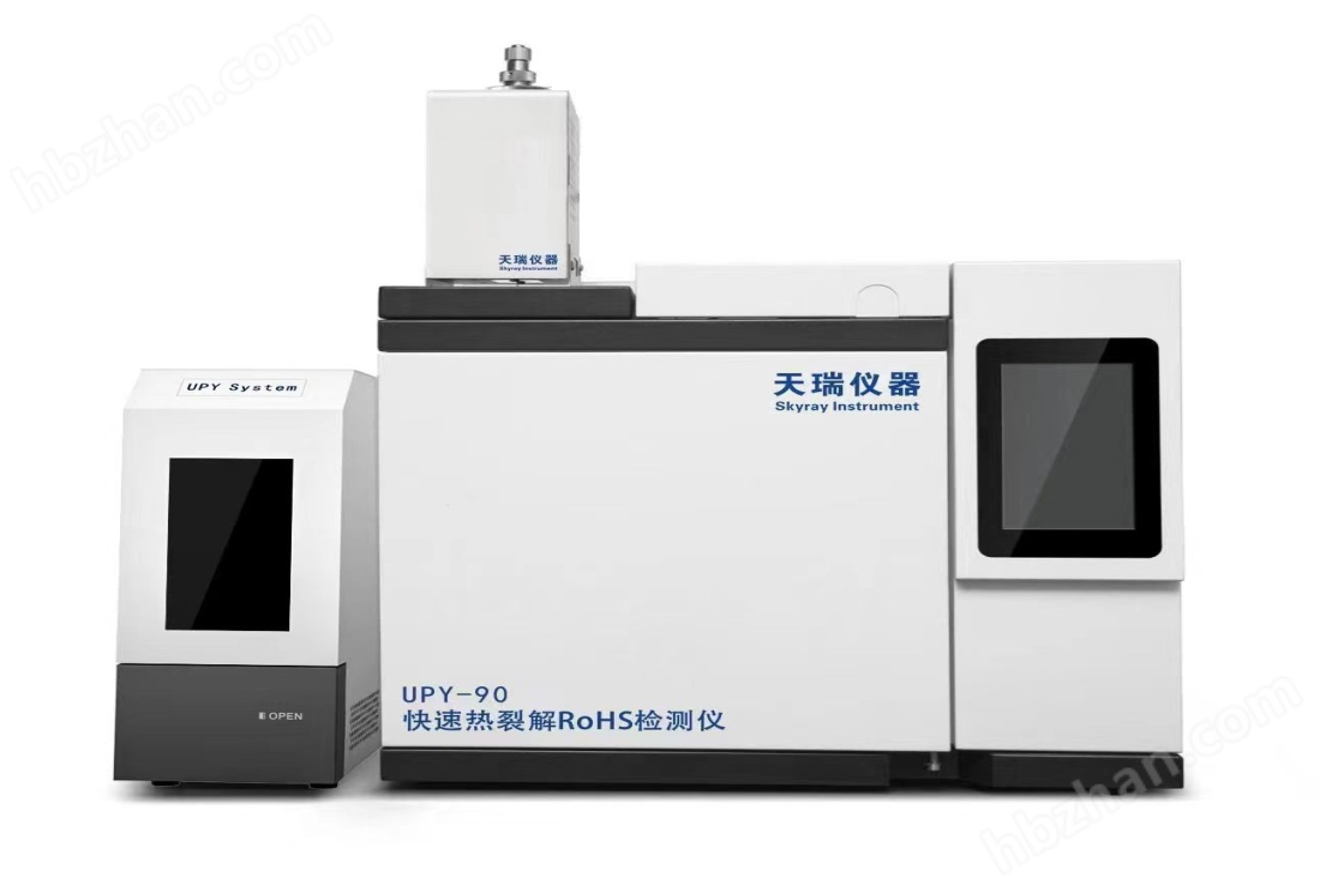
UPY-90 is a rapid pyrolysis RoHS testing equipment suitable for rapid screening and detection of phthalate 4P (DIBP, DBP, BBP, DEHP) in the RoHS 2.0 directive (EU 2015/863).
In March 2017, the Py/TD-GC-MS method was approved by the International Electrotechnical Commission (IEC) as an approved method (the national standard has also been approved and is in a pending state). This method is used to analyze the phthalates restricted by the RoHS directive (IEC 62321-8:2017) for the regulation of electronic and electrical products.
Py/TD-GC, as a low configuration alternative to Py/TD-GC-MS, has been extensively tested and meets the screening requirements for RoHS 2.0 ortho benzene in enterprises.
1Application field
EDX-1800BROHS detector isAn economical, practical, and easy-to-use X-ray fluorescence spectrometer;It has good detection limits and accuracy for elements such as lead (Pb), mercury (Hg), cadmium (Cd), chromium (Cr), bromine (Br), chlorine (Cl), etc.Comprehensive application of FP method, neural network method, empirical coefficient method, and basic parameter method analysis software. RoHS/WEEE/EN71 standard/ELV directive related control requirements can be met. The carefully designed open working curve function is particularly suitable for controlling multi material factory processes.
EDX-1800BROHS testerSuitable for: hardware, connectors, electronics, electrical, connectors, electroplating, PCB, ROHS analysis and eight heavy metal analysis of incoming materials such as plastic, leather, and shoe materials.
2、 Product Features (Test Object:Powder, solid, liquid)
1. Rapid elemental analysis from sulfur (S) to uranium (U);
2. Detection sensitivity ranging from 0.01% to 99.99%;
3. Short measurement time, each measurement only requires 60-200 seconds.
45Million pixel color CCD system for sample image observation.
5. There are multiple specifications availableCollimator and filterSelection,5groupcollimator and4 groupsoptical filtercombinationElectric automatic switching, meeting various material testing methods applications.
6. Electric cooling Si Pin detector improves measurement stability,Improve the accuracy of analysis without the need for consumables.
7. Simple and reliable mechanical structure
8Qualitative and quantitative analysis algorithms:FP basic algorithm,Empirical coefficient method, neural network method, basic parameter method;
9The fully enclosed metal chassis and anti leakage protection switch design better ensure the personal safety of operators. Flowing appearance, beautiful and elegant,The internal space of the instrument is a large sample cavity, with excellent ventilation and effective shielding of electromagnetic interference
10The ultra short optical path design of,windCold type X-ray tubeSupporting light pipe control programProgram, better heat dissipation,A good heat dissipation system can ensure the long-term use of the instrument,And it can effectively extend the lifespan of X-ray tubes
11Up type: It can meet the testing needs of various shapes of samples, and the precise sample imaging collimation system achieves accurate point measurement of samples.
12、Automatic spectral line recognition, simultaneous qualitative and quantitative analysis of multiple elements, allowing users to easily understand the composition of the analyzed samples, and automatic safety protection switches are set up to ensure user safety during use.

1. Lead (Pb): Lead is a toxic heavy metal widely used in circuit boards and solder. The toxicity of lead can have serious effects on the nervous system, blood system, and kidneys, especially in children. The RoHS directive stipulates that the lead content shall not exceed 0.1% (1000 ppm). Reducing the use of lead can effectively reduce environmental pollution and health risks.
2. Mercury (Hg): Mercury is a highly toxic metal commonly used in switches and relays. Mercury and its compounds can enter the food chain through biological accumulation, causing serious damage to the human nervous system, digestive system, and immune system. The RoHS directive stipulates that the mercury content shall not exceed 0.1% (1000 ppm). The control of mercury can significantly reduce its harm to ecosystems and human health.
3. Cadmium (Cd): Cadmium is a toxic heavy metal commonly used in batteries, electroplating, and pigments. Cadmium can cause serious damage to the kidneys, bones, and respiratory system, and is carcinogenic. The RoHS directive stipulates that the cadmium content shall not exceed 0.01% (100 ppm). Strictly controlling the use of cadmium can prevent soil and water pollution, protect the ecological environment and public health.
4. Hexavalent chromium (Cr6+): Hexavalent chromium is mainly used for metal coatings and has anti-corrosion properties. Hexavalent chromium has strong carcinogenicity and can cause serious harm to the skin, respiratory system, and internal organs. The RoHS directive stipulates that the hexavalent chromium content shall not exceed 0.1% (1000 ppm). Reducing the use of hexavalent chromium can lower the pollutant content in industrial wastewater and exhaust gas, protecting the occupational health and public health of workers.
5. Polybrominated biphenyls (PBBs): PBBs are flame retardants, commonly used in plastics, foam and textiles. Polybrominated biphenyls have persistence and bioaccumulation, posing potential hazards to the environment and human health. The RoHS directive stipulates that the content of polybrominated biphenyls shall not exceed 0.1% (1000 ppm). By restricting the use of polybrominated biphenyls, their accumulation in the environment can be reduced and the toxicity risk in the food chain can be lowered.
6. Polybrominated diphenyl ether (PBDE): PBDE is a common flame retardant widely used in plastic casings and cables of electronic products. Polybrominated diphenyl ethers can enter the human body through air, dust, and food, affecting thyroid hormones and the nervous system. The RoHS directive stipulates that the content of polybrominated diphenyl ethers shall not exceed 0.1% (1000 ppm). Restricting the use of polybrominated diphenyl ethers can help reduce their harm to the environment and human health.
7. Di (2-ethylhexyl) phthalate (DEHP): DEHP is a plasticizer commonly used to soften plastic products such as cables and flooring. DEHP has endocrine disrupting properties and can have adverse effects on the reproductive system and development. The RoHS directive stipulates that the DEHP content shall not exceed 0.1% (1000 ppm). Reducing the use of DEHP can lower its potential risks to the health of children and adults.
8. Phenylbutyl phthalate (BBP): BBP is also a plasticizer widely used in PVC plastic products. BBP has endocrine disrupting and reproductive toxicity, which can have negative effects on fertility and fetal development. The RoHS directive stipulates that the BBP content shall not exceed 0.1% (1000 ppm). Controlling the use of BBP can help protect human reproductive health and child development.
9. Dibutyl phthalate (DBP): DBP is commonly used as a plasticizer in adhesives, sealants, and textile coatings. DBP has endocrine disrupting properties and can affect the reproductive system and developmental processes. The RoHS directive stipulates that the DBP content shall not exceed 0.1% (1000 ppm). By restricting the use of DBP, its harm to the environment and health can be reduced.
10. Diisobutyl phthalate (DIBP): DIBP is another common plasticizer mainly used in plastic products and coatings. DIBP has potential toxicity to the reproductive system and development. The RoHS directive stipulates that the DIBP content shall not exceed 0.1% (1000 ppm). Controlling the use of DIBP can help reduce its impact on human health and the environment.
RoHS 2.0 Hazardous Substance Solution for Coatings and Inks--Tianrui Instrument
Software functions:
1. The software allows for video observation of the placement of samples;
2. Simultaneously capable of analyzing dozens of elements, with analysis time as short as 1-2 minutes;
3. Can automatically perform qualitative analysis and report;
4. Can automatically initialize and calibrate the instrument;
5. Having multiple spectral fitting analysis methods;
Introduction to the functions of RoSH analysis software:
1. Detecting five elements (Cd, Pb, Hg, Br, Cr) and Cl involved in six substances in the RoHS directive
2. The specialized software designed for RoHS testing is more targeted;
3. The operation interface is simple, easy to use, and does not require professional operation;
4. The interface automatically switches between Chinese and English, and has a three party language editing function;
5. When testing different samples, the collimator can be automatically switched by software settings;
6. Convenient report output method that can be imported into an EXCEL spreadsheet; And there is a non editable independent report output format;
7. The calibration of instruments is convenient and simple;
8. And it can display measurement results in real time, making it convenient for customers to shorten measurement time;
9. And it can perform rough material judgment on the sample.
Tianrui ROHS halogen detector, halogen detection instrument application fields:
1. RoHS testing analysis;
2. Eight major heavy metal detection methods;
3. Measurement of thickness of metal coatings and determination of plating solution and coating content;
4. Elemental analysis of resources such as geology and minerals;
5. Testing institutions; Electroplating industry.
According to the new RoHS 2.0 testing standard, production enterprises need to purchase GC-MS and other testing equipment for rapid screening of raw materials, self inspection of materials, internal quality control, and customer factory inspection. However, the cost of purchasing these equipment is high, and completing the testing requires configuring a series of pre-treatment equipment and various chemical reagents. The testing cost is high, the steps are complicated and time-consuming, and the requirements for analysts are high, which brings many inconveniences to customers;
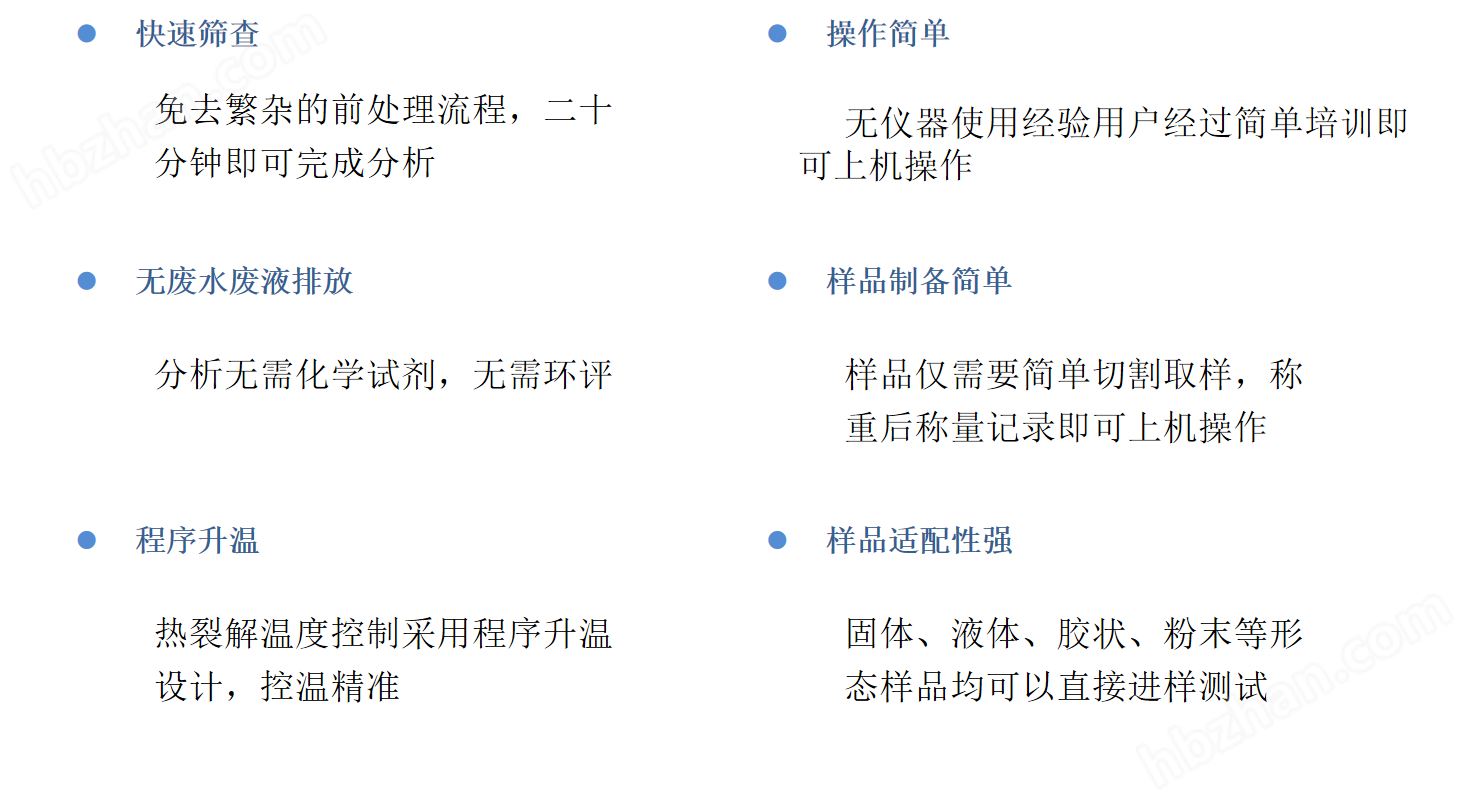
Jiangsu Tianrui Instrument Co., Ltd. has developed a new solution specifically for the rapid screening needs of four newly added phthalates in RoHS2.0: "RoHS2.0 Newly Added Four Phthalates Quality Control Screening Solution"; This scheme uses a rapid pyrolysis RoHS detector (UPY-90), which does not require chemical pretreatment for solid and liquid samples, and can be directly injected for testing, simplifying the operation steps, reducing analysis difficulty and cost, and improving detection efficiency.
Compared to traditional chemical methods, the use of UPY-90 rapid pyrolysis RoHS detector (Py/TD-GC method) can quickly screen for phthalates in electronic and electrical products. This method does not require chemical pretreatment, says goodbye to organic solvents, and directly weighs the sample for machine analysis to obtain the final test results. It is simple and fast, and is one of the effective detection methods for enterprise internal control.
UPY-90 simple steps: sample cutting - weighing - machine testing
Similar Product Recommend