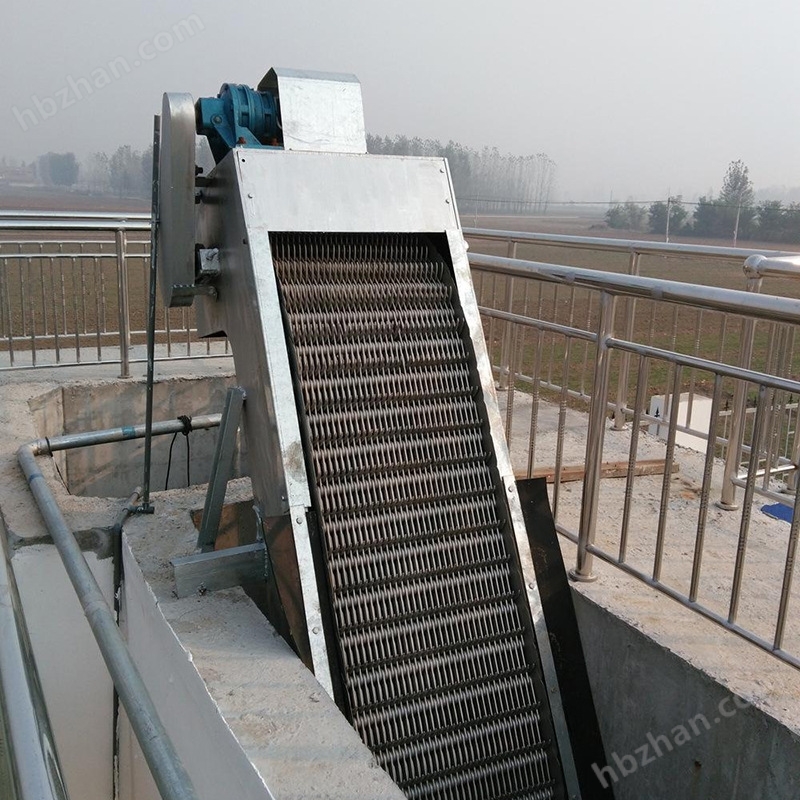
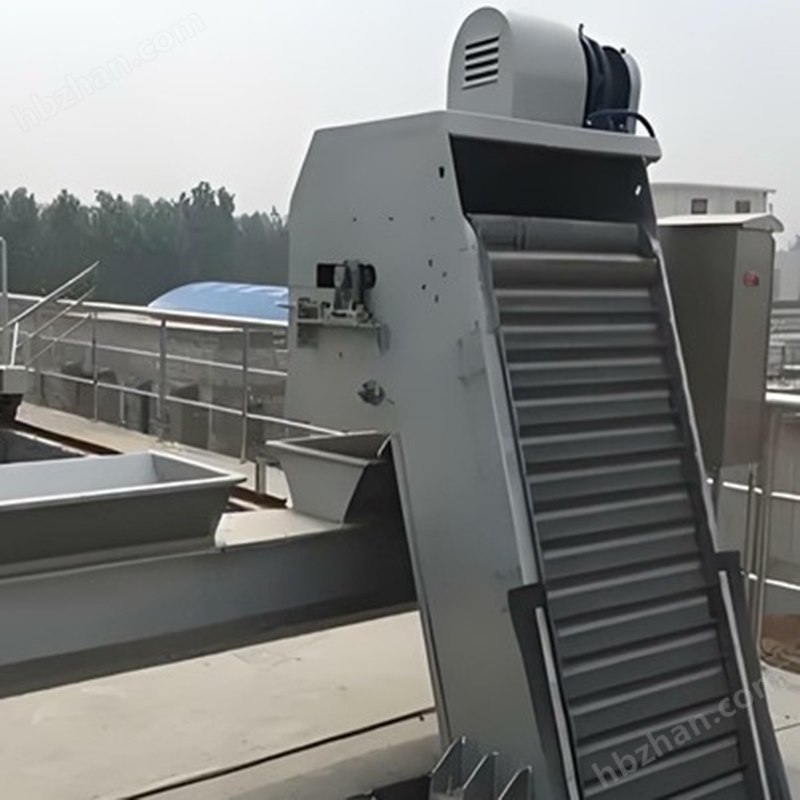
The specifications of the rotary tooth rake cleaning machine and the circulating tooth rake grid cleaning machine are divided according to the machine width, covering GSLY300-3600 models, and the corresponding models adopt parallel design. The core configuration and selection of $r $n are based on the multi specification selection of $r $n rake teeth gap, including 1mm, 3mm, 5mm, 10mm, 20mm, 30mm, 40mm, 50mm, etc. The selection of $r $n should take into account factors such as water flow rate, lifting height, total solid-liquid separation capacity, as well as the shape and particle size of the separated material, and can also be matched with different materials. $r $n size adaptation and customization services $r $n devices can be flexibly extended according to user needs and actual usage scenarios.
As an efficient water treatment equipment adapted to the northern environment, the circulating toothed rake cleaning machine (also known as the fine grid cleaning machine) can continuously and automatically intercept and remove various forms of debris in the fluid. It is widely suitable for urban sewage treatment, tap water production, power plant inlet and other scenarios. At the same time, it can also be used as a front-end screening equipment for wastewater treatment processes in industries such as textile, food processing, papermaking, leather, etc. It has become the mainstream application equipment in China's solid-liquid screening field.
The core of the equipment is assembled with dedicated rake teeth to form a rotating grid chain. Driven by the motor reducer, the grid chain continues to rotate in the opposite direction of the water flow.
When the rake chain is transported to the upper area of the equipment, with the precise guidance of the groove wheel and curved rail, a relative self-cleaning action will be generated between each set of rake teeth. The vast majority of solid debris naturally falls off by its own gravity, while stubborn debris adhering to the rake teeth surface is cleaned by reverse scraping with a cleaner.
Looking along the direction of water flow, the rake chain is equivalent to a dynamically operable grille, and the clearance between the rake teeth assembled on its shaft can be flexibly selected according to actual working conditions. After the rake teeth complete the separation of solid suspended solids in the fluid, it can ensure smooth water flow, and the entire operation process supports continuous or intermittent operation, adapting to different processing requirements.
The equipment specifications are divided according to the width dimension, covering the entire series of GSLY300-3600 models. The corresponding models adopt parallel design to ensure high flow processing requirements.
The rake teeth grid gap provides multiple options, including 1mm, 3mm, 5mm, 10mm, 20mm, 30mm, 40mm, 50mm and other specifications, suitable for screening different particles and debris.
The selection should be based on the actual working conditions such as water flow rate, lifting height, total solid-liquid separation, as well as the shape and particle size of the material to be separated. At the same time, special materials that are resistant to low temperature and wear can be selected according to the environmental characteristics of low temperature and high sediment in the north.
The equipment can be flexibly extended and customized according to the actual installation needs and on-site usage scenarios of the user.
We can provide customized design services tailored to the personalized specification requirements of special working conditions in the north, such as deep trench operations and adaptation to low-temperature and severe cold environments
Rotary tooth rake cleaning machine, circulating tooth rake grille cleaning machine
The circulating rake cleaning machine is a water treatment equipment that can continuously and automatically intercept and remove various forms of debris in the fluid, with a wide range of application scenarios. It is suitable for impurity filtration in urban sewage treatment, water supply industry, and power plant inlet, and can also be used as a front-end screening equipment for wastewater treatment processes in industries such as textile, food processing, papermaking, leather, etc. It is one of the mainstream application equipment in China's current solid-liquid screening field.