-
E-mail
shlishen@163.com
- Phone
-
Address
2999 Lane, Gonghe New Road, Shanghai
Product Categories
Shanghai Lishen Pump Manufacturing Co., Ltd
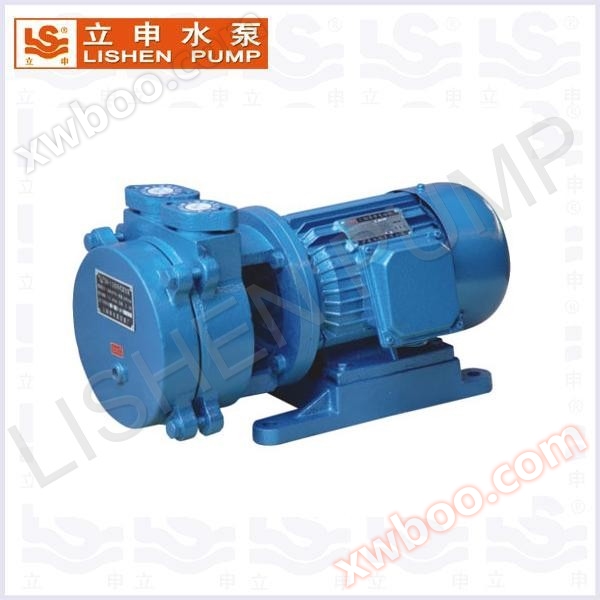
SK type direct connected water ring vacuum pump
NegotiableUpdate on 03/27
- Model
- Nature of the Manufacturer
- Producers
- Product Category
- Place of Origin
Overview
SK type direct coupled water ring vacuum pump is widely used in industries such as machinery, petroleum, chemical, pharmaceutical, food, ceramic printing and dyeing, metallurgy, etc. It is also suitable for large-scale water pump water intake. Due to the isothermal compression of gas during the working process, it is less likely to cause danger when extracting corrosive, flammable, and explosive gases. SK-0.4, SK-0.8, SK-1.0, SK-1.5B direct coupled water ring vacuum pumps are used to suction air and other non corrosive, insoluble, and solid particle free gases to create a vacuum in a closed container. A small amount of liquid is allowed in the inhaled gas.
Product Details
Overview
1、 What is Lishen SK type direct connected water ring vacuum pump:
SK type direct coupled water ring vacuum pump is widely used in industries such as machinery, petroleum, chemical, pharmaceutical, food, ceramic printing and dyeing, metallurgy, etc. It is also suitable for large-scale water pump water intake. Due to the isothermal compression of gas during the working process, it is less likely to cause danger when extracting corrosive, flammable, and explosive gases. SK-0.4, SK-0.8, SK-1.0, SK-1.5B direct coupled water ring vacuum pumps are used to suction air and other non corrosive, insoluble, and solid particle free gases to create a vacuum in a closed container. A small amount of liquid is allowed in the inhaled gas.
2、 Structural diagram of SK type direct connected water ring vacuum pump:

The structure of SK type cantilever water ring vacuum pump is shown in Figure 2: mainly composed of pump cover, impeller, and pump body. The upper part of the pump body has inlet and outlet flanges, and the shaft is eccentrically installed in the pump body. The impeller is fixed to the shaft with a flat key. The gap between the impeller, pump cover, and disc is adjusted by the cushion between the pump body and disc. This gap determines the size of gas loss in the flow from the inlet to the outlet in the pump.
The packing is installed inside the pump body, and the sealing water flows into the packing through the pinhole on the pump body. The supplementary water required for the impeller to form a water ring is supplied through the elbow on the pump body, which can be connected with tap water or soda water separator to supply circulating water.
There are several rows of circular holes under the exhaust holes on the disc, which are closed with rubber ball valves. The purpose of these holes is to automatically release gas before the exhaust port when the gas pressure between the blades reaches the exhaust force, thereby reducing power consumption due to excessive gas pressure.
Analysis of Working Principle

The SK type direct coupled water ring vacuum pump is a cantilever structure, as shown in Figure 1. The impeller (1) is eccentrically installed inside the pump body (2). Therefore, when the impeller rotates, water is subjected to centrifugal force, forming a rotating water ring (3) on the pump wall. The upper part of the water ring is tangent to the hub and rotates in the direction of the arrow. During the first half of the rotation, the inner surface of the water ring gradually separates from the wheel, forming a space between the impeller blades and gradually expanding. This allows gas to be sucked in from the suction port. During the second half of the rotation, the inner surface of the water ring gradually approaches the hub, and the volume of the space between the blades gradually decreases. The gas between the blades is compressed and discharged.
In this way, every time the impeller rotates, the space area between the blades changes once, and the water between each blade reciprocates like a piston, and the pump continuously sucks in gas.
Due to the heat generated by water during work, some of the water and gas are discharged together. Therefore, the pump must continuously supply cold water to cool and replenish the water consumed inside the pump.
When the gas discharged from the SK type direct connected water ring vacuum pump is exhaust gas, a water tank can be connected to the exhaust end. After the exhaust gas and a part of the water carried out are discharged into the water tank, the gas is discharged through the exhaust pipe of the water tank, and the water falls into the bottom of the water tank and returns to the pump for use through the return pipe. If the water circulation time is long and the water heats up, then supply a certain amount of cold water with energy from the water tank supply.
Usage and maintenance
1. Before starting the SK type cantilever water ring vacuum pump, it is necessary to check whether the motor rotation direction matches the pump rotation direction. After starting the vacuum pump, adjust the size of the water inlet, and then check whether the packing is properly compressed (normal packing compression can make the water in the pump drip outwards). SK-1.5B should first add water before starting the vacuum pump, and then adjust the size of the water inlet. Check whether the bearing operation and lubrication are normal.
2. After starting the SK type cantilever water ring vacuum pump, it is necessary to observe whether there is vibration, listen carefully for any noise inside the SK type cantilever water ring vacuum pump, and measure the temperature of the packing box and bearings (the normal bearing temperature should not be higher than the ambient temperature by 35 ℃, and the working temperature should not be higher than 70 ℃). If the temperature is too high, it should be stopped immediately to check the cause.
3. When the SK type cantilever water ring vacuum pump is used as a water pump for vacuum water intake, all the air inside the pump is sucked out during operation until the water is sucked out from the SK type cantilever water ring vacuum pump, then the water pump is started. After the water pump is working normally, the vacuum pump is stopped and the valve of the suction pipeline is closed.
4. SK type cantilever water ring vacuum pump shutdown sequence
(1) Close the gate valve on the intake pipeline
(2) Close the gate valve on the water supply pipeline. It is not advisable to stop the pump immediately after stopping the water supply. The pump should continue to run for 1-2 minutes to discharge some working fluid. Mechanical seals should first stop the pump and then stop the water supply.
(3) Turn off the electric motor.
(4) If the parking time exceeds one day, the screw plug at the bottom of the pump cover must be opened to drain the water from the pump body.
5. When using SK type cantilever water ring vacuum pump under the following conditions, auxiliary equipment should be added.
(1) The defendant must install a filter on the intake pipe to remove dust from the air or gas.
(2) When the extracted gas contains a large amount of vapor, a condenser must be installed on the intake pipe.
(3) When extracting corrosive gases, neutralization must be carried out before entering the pump.
(4) When the temperature of the extracted gas exceeds 35 ℃, it must pass through a condensing device before entering the pump to ensure that the temperature does not exceed 35 ℃.
(5) When the extracted gas contains a large amount of liquid, a steam water separator must be installed in front of the intake pipe.
(6) The starting current of SK type cantilever water ring vacuum pump is often several times the rated current of the motor, and a starting switch must be equipped.
Note: ① The SK type cantilever water ring vacuum pump of our unit may be changed without prior notice due to technological improvements and other reasons.
6. SK type cantilever water ring vacuum pump should regularly check the operation and lubrication of the rolling ball bearings.
The rolling bearings of SK type cantilever water ring vacuum pump working normally should have a temperature 15 ℃~20 ℃ higher than the surrounding temperature, and the maximum temperature should not exceed 55 ℃~60 ℃. The bearings working normally should be filled with oil 3-4 times a year. Clean the bearings at least once a year and replace all lubricating oil.
8. SK type cantilever water ring vacuum pump should regularly tighten the packing. If the packing cannot guarantee the required sealing due to wear, it should be replaced with new packing. The packing should not be too tight. Normally tightened packing allows water to drip out, and the amount should not be too much. Oil immersed asbestos rope should be used as packing.
Start and stop
(1) SK type cantilever water ring vacuum pump starting:
Before starting a pump that has been parked for a long time, the coupling must be manually rotated several times to confirm that there is no jamming or damage.
1. Close the gate valve (2) on the intake pipe (Figure 11).
If a gate valve (9) is installed on the exhaust pipe of the SK cantilever water ring vacuum pump, it should also be closed.
3. Fill the stuffing box and gas water separator with water.
When the gas water separator overflows water, start the electric motor.
5. Fully open the ball valve (7) on the water supply pipeline (6) from the gas water separator to the pump.
6. Open the gate valve (9) on the exhaust pipe.
7. Open the gate valve (2) on the intake pipe.
8. Use a spherical valve (7) to adjust the amount of water sent from the air-water separator to the SK type cantilever water ring vacuum pump, in order to operate under the required technical conditions and minimize power consumption.
9. Adjust the water supply from the inlet pipe (5) to the air-water separator to minimize water consumption and ensure the required technical specifications of the pump.
10. Adjust the water supply to the stuffing box to ensure the sealing of the stuffing box with minimal water consumption. When the vacuum pump works at the maximum vacuum degree, due to the generation of water inside the pump
The explosion sound is generated by physical action, but the power consumption does not increase.
The explosion sound generated as power consumption increases indicates that the pump has malfunctioned and should be stopped at this time.
(2) SK type cantilever water ring vacuum pump stops, and the vehicle is parked in the following order:
1. Close the gate valve (2) on the intake pipe (Figure 11).
2. Close the gate valve (9) on the exhaust pipe.
3. Turn off the electric motor.
4. Stop injecting water into the packing and gas water separator.
5. When the overflow pipe of the gas separator stops overflowing, close the water injection pipeline to the pump.
6. Tighten the ball valve.
When stopping the SK type cantilever water ring vacuum pump, it is necessary to unscrew the pipe plugs on the pump and gas water separator to drain the water completely.
performance curve

performance parameters

Note: The data listed in the table can be obtained under the following conditions:
1. Atmospheric pressure 0.1013Mpa (760mmHg)
2. Inlet water temperature 15 ℃
3. Inhalation air temperature 20 ℃
4. Air relative humidity 70%
5. Performance allowable deviation ± 10%
Similar Product Recommend