-
E-mail
yroke@126.com
-
Phone
13968989215
-
Address
Ma'ao Industrial Park, Oubei Town, Yongjia County
Product Categories
Yongjia Yingke Pump Valve Co., Ltd
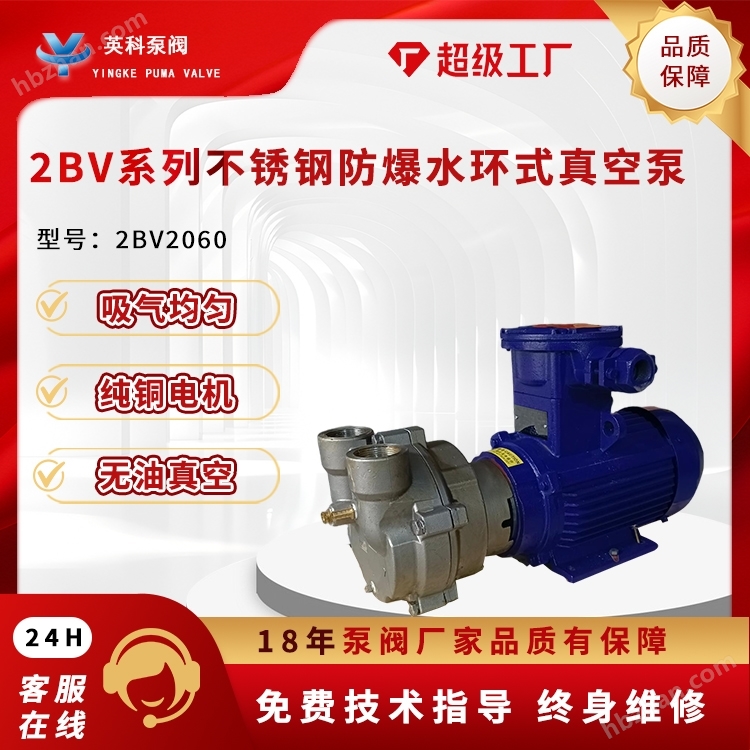


Stainless steel explosion-proof water ring vacuum pump
NegotiableUpdate on 01/08
- Model
- Nature of the Manufacturer
- Producers
- Product Category
- Place of Origin
Overview
The 2BV2060 stainless steel explosion-proof water ring vacuum pump is equipped with an eccentric rotor with fixed blades, which throws water (liquid) towards the stator wall, forming a liquid ring concentric with the stator. The liquid ring, together with the rotor blades, forms a variable volume rotating variable volume vacuum pump.
Product Details
2BV2060Stainless steel explosion-proof water ring vacuum pump
2BV2060Stainless steel explosion-proof water ring vacuum pump


With the increasing application of water ring pumps, equipment is often affected by harsh environments such as high temperature, high pressure, strong corrosion, and cavitation erosion during operation, resulting in wear, corrosion, leakage, and other phenomena that restrict the normal production of enterprises, and even lead to serious safety accidents such as fires, explosions, and pollution. At the same time, unexpected shutdowns caused by equipment failures also affect production efficiency and product quality, increasing the cost investment of enterprises. According to statistics, in most manufacturing industries, the cost of equipment maintenance and repair accounts for 20% -30% or even more of the total expenditure.
1. Repair of wear and tear on the bearing position of the water ring vacuum pump shaft
The wear and tear of transmission parts is a common equipment problem in production-oriented enterprises, with a large number and frequent damage, including various shaft, roller, reducer, motor, pump and other bearing positions, bearing seats, bearing chambers, keyways and threads.
Solution:
The traditional welding machine processing method is prone to material damage, resulting in component deformation or fracture, and has significant limitations; The methods of brush plating and spray coating followed by machining often require outsourcing, which not only results in long repair cycles and high costs, but also cannot fundamentally solve the causes of wear due to the fact that the repaired materials are still metal materials (metal has poor impact resistance and retreat ability).
Repair steps:
1. Mold processing: making standard split molds
2. Surface treatment: degreasing, polishing, cleaning to ensure a clean, dry, and sturdy surface.
3. Mixing materials: Accurate proportion and even mixing.
4. Coating material: Ensure adhesion, filling, and thickness.
5. Install mold: Apply release agent, install and fix to ensure excess material is squeezed out.
6. Demolding: After solidification, dismantle the mold to clean up excess materials. The materials should not be knocked and can be removed using tools such as polishing machines and files to meet installation requirements.
2. Repair of corrosion and erosion of water ring vacuum pump
The forms of metal corrosion can be divided into two categories: comprehensive (uniform) corrosion and localized corrosion. The former occurs more uniformly on the entire surface of the device, while the latter only occurs locally. For example, pitting corrosion, crevice corrosion, intergranular corrosion, stress corrosion cracking, corrosion fatigue, hydrogen corrosion cracking, wear corrosion, delamination corrosion, etc.
The use of polymer composite repair materials for surface organic coating anti-corrosion is one of the effective anti-corrosion measures. Surface adhesive coating protection can be widely used for repairing and pre protective coatings of abrasion, cavitation, and corrosion areas. It has good chemical resistance and excellent mechanical and adhesive properties. Compared with traditional pressure vessel welding repair, it has the characteristics of simple construction, low cost, safety performance, and good repair effect.
Repair steps:
(1) Surface treatment: Remove the surface oxide layer and clean the surface with acetone.
(2) Mixing materials: strictly mix according to the proportion and stir evenly until there is no color difference.
(3) Application material: First, apply a thin layer of material to ensure adhesion and coverage, then evenly apply the material to the repair surface to achieve the required repair thickness.
(4) Curing: 24 hours/24 ℃ (material temperature). For every 11 ℃ increase in material temperature, the curing time is reduced by half, but the temperature increase must not exceed the material's withstand temperature.
(5) Installation and precautions: Install according to the assembly requirements, and the materials for repair and protection should avoid being struck or impacted by external forces. If the materials affect the assembly, they can be polished and must not be struck to avoid damaging other materials.
Reasons and removal of scaling in scale vacuum pump
With the development of acidic papermaking to neutral papermaking, scaling of papermaking water ring vacuum pumps is a common problem encountered by every papermaking enterprise, whether in the south or north. Scaling is a process that does not occur overnight. As scaling occurs, its impact on paper machines gradually becomes apparent. Therefore, we cannot take it lightly and must persist in controlling and preventing scaling from the beginning, which will produce long-term benefits.
(1) Reason for scaling:
Impact on water quality. High pH value and high hardness.
The sealing degree of papermaking white water increases, the content of insoluble substances is high, and scaling ions accumulate.
The extensive use of fillers.
Temperature. The water temperature has risen, and the cooling system is not functioning properly.
The lack of regular cleaning and maintenance of the water circulation system can increase the possibility of scaling in the papermaking water ring vacuum pump.
(2) Adverse effects on papermaking:
Seriously reduce the vacuum degree and pumping volume.
The increase in motor current leads to an increase in power consumption.
Often causing problems such as vacuum pump jamming, difficulty starting, and paper machine stopping while the vacuum pump dare not stop.
Frequent acid washing or manual disassembly not only damages the equipment, but also destroys its accuracy, resulting in the inability to form a vacuum or a decrease in vacuum degree.
(3) Solution:
For a long time, traditional cleaning methods such as mechanical methods (scraping, brushing), high-pressure water, chemical cleaning (acid washing), etc. have encountered many problems when cleaning equipment: they cannot remove deposits such as scale, acid solution corrodes equipment and forms loopholes, residual acid causes secondary corrosion or corrosion under scale on materials, ultimately leading to equipment replacement. In addition, the cleaning waste liquid is toxic and requires a large amount of funds for wastewater treatment.


