-
E-mail
yilifm@163.com ,9715905@qq.com
-
Phone
13868807962
-
Address
Yili Valve Industrial Park, Wuxing Industrial Park, Oubei New District, Yongjia County, Wenzhou City, Zhejiang Province
Product Categories
Zhejiang Yili Valve Co., Ltd
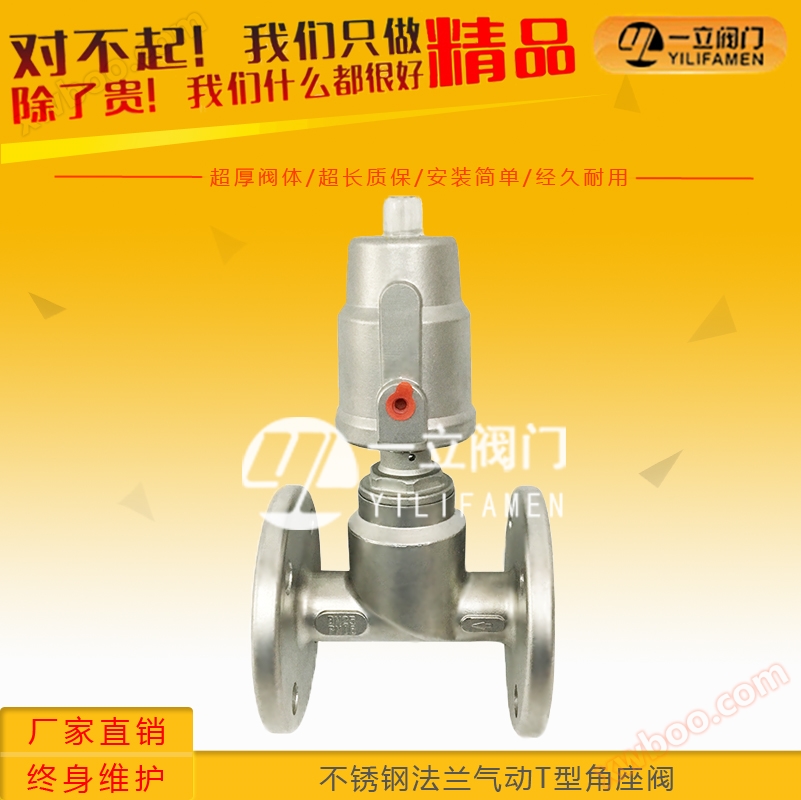
Stainless steel flange pneumatic T-shaped angle seat valve
NegotiableUpdate on 04/06
- Model
- Nature of the Manufacturer
- Producers
- Product Category
- Place of Origin
Overview
Product application: Made mainly of 304 stainless steel, it is widely used in fluid control in various industries, including beer and beverage, textile printing and bleaching, pharmaceutical and medical equipment, food processing, rubber machinery, organic and inorganic chemicals, cleaning, disinfection, high temperature sterilization, etc,
Product Details
Product Overview:
Stainless steel pneumatic angle seat valve, guaranteed quality, and discounted price. The angle seat valve is mainly oriented towards easy installation. The product is widely used in beer and beverage machinery, pharmaceutical and medical equipment, food processing, etc. Applicable media: steam, gas, liquid, corrosive fluid, etc. Welcome customers to make purchases.
Pneumatic angle seat valve can save space by maintaining flow rate. It is a directional angle seat valve operated by a single acting pneumatic actuator with spring safety protection. When using, it should be selected as normally open or normally closed·
Pneumatic angle seat valves are widely used for short-term frequent starting, with the characteristics of sensitive response and accurate action. When used in conjunction with solenoid valves, pneumatic control can accurately control gas and liquid flow rates. It can meet the requirements of accurate temperature control and liquid dripping. The wet heat sterilization cabinet should use angle seat valves to control steam volume and temperature accurately.
Single acting and double acting; Single acting (pneumatic head usually has one hole); working principle; According to the function of spring reset to achieve opening and closing, it is divided into normally open and normally closed types. Double acting (pneumatic head usually has two holes); Working principle: Control its switch by supplying air. High flow rate, low flow resistance, and no water hammer.
The Y-shaped design expands the flow cross-section of the valve chamber, making the fluid inside the valve chamber smoother and increasing the flow rate by 30%.
Product application:
Using 304 stainless steel as the main material, it is widely used in fluid control in various industries, including beer and beverage, textile printing and bleaching, pharmaceutical and medical equipment, food processing, rubber machinery, organic and inorganic chemicals, cleaning, disinfection, high-temperature sterilization, water treatment and other industries. The applicable media include water, liquids, neutral gases, water vapor, slightly corrosive gases and liquids. Compared with solenoid valves and other valves, it has the characteristics of economical investment, safe use, maintenance free, and long service life. With the widespread application of industrial automation technology, the use of PLC and container control valves can achieve centralized and remote control of the pneumatic valve, reducing various environmental and human interference, thereby further improving the equipment level of enterprises
Using 304 stainless steel as the main material, it is widely used in fluid control in various industries, including beer and beverage, textile printing and bleaching, pharmaceutical and medical equipment, food processing, rubber machinery, organic and inorganic chemicals, cleaning, disinfection, high-temperature sterilization, water treatment and other industries. The applicable media include water, liquids, neutral gases, water vapor, slightly corrosive gases and liquids. Compared with solenoid valves and other valves, it has the characteristics of economical investment, safe use, maintenance free, and long service life. With the widespread application of industrial automation technology, the use of PLC and container control valves can achieve centralized and remote control of the pneumatic valve, reducing various environmental and human interference, thereby further improving the equipment level of enterprises
The flange type pneumatic angle seat valve has the characteristics of quick installation and easy disassembly.
According to the cylinder, it can be divided into:
Single acting and double acting
Single acting (pneumatic head usually has one hole); working principle; According to the function of spring reset to achieve opening and closing, it is divided into normally open and normally closed types.
Double acting (pneumatic head usually has two holes); Working principle: Control its switch by supplying air.
The quick installation angle seat valve has the characteristics of easy installation and disassembly, which can better serve the replacement and installation of pipelines.
parameter
Actual application parameters of pneumatic angle seat valve:
Pressure range: 0-1.6Mpa
Medium temperature: -10 ℃~+200 ℃
Environmental temperature: -10 ℃~+120 ℃
Function and working principle;
Flange type pneumatic valves are divided into single acting and double acting according to the air source interface; Single acting (pneumatic head usually has one hole); working principle; According to the function of spring reset to achieve opening and closing, it is divided into normally open and normally closed types. Double acting (pneumatic head usually has two holes); Working principle: Control its switch by supplying air. High flow rate, low flow resistance, and no water hammer.
Product Features:
1. Visual position indication: can be connected to limit switches or emergency manual devices.
2. Easy to install: The pneumatic control head can rotate 360 ', and even the limit switch can rotate 360'. One to two limit switches can be easily installed.
3. Advanced pneumatic controller: thickened engineering plastic shell, safe and reliable. Low wear piston structure with large capacity and low air consumption. Internal components are self-lubricating and maintenance free.
4. It has multiple control modes: normally open, normally closed, and double acting.
5. Require smaller pneumatic actuators: When fluid flows in from above the valve stem, the head should be stopped.
6. Easy to connect: MAMUR standard connection, embedded metal joint. Choose a smaller control head.
7. Long life guide rod: The valve stem is sealed with PTFE (PTFE) to prevent dirt from entering. Self lubricating, maintenance free. The valve stem has been specially treated to ensure optimal fixation and can automatically correct its position.
8. No water hammer effect: When fluid flows in from below the valve stem, water hammer (water impact force) is absorbed.
9. Advanced valve body mechanism: The flow rate is 30% higher than that of ordinary corner seats, the volume is smaller, and the fluid flow state is better. Stainless steel 316 valve body, PTFE seal, high temperature resistance, corrosion resistance. The single acting angle seat valve has the advantages of simple structure, beautiful appearance, quick assembly and disassembly, quick opening and closing, flexible operation, low fluid resistance, and safe and reliable use.
10. All steel components are made of acid resistant stainless steel materials, and the seals are made of food grade silicone rubber or polytetrafluoroethylene materials, which comply with food hygiene regulations. Widely applicable to many industries such as food, brewing, beverages, dairy products, fine chemical pharmaceuticals, and biotechnology.
11. Scope of application: Used in filling equipment, beer and beverage, textile printing and dyeing, medical equipment, biopharmaceuticals, disinfection and sterilization, food industry, rubber and plastic machinery, HVAC, etc.
Connection size:
Connection size:
| Connection method and standards |
Nominal Diameter | actuator | Inner hole diameter (mm) | KV 值(m3/h) | Order Number | |
| Single pneumatic control | Dual pneumatic control | |||||
| Flange type DIN2533 | DN25 | 50 | 24 | 18.1 | 2215825-50 | 2214825-50 |
| DN25 | 63 | 24 | 18.1 | 2215825-63 | 2214825-63 | |
| DN32 | 63 | 31 | 32.1 | 2215832-63 | 2214832-63 | |
| DN40 | 63 | 35 | 32.9 | 2215840-63 | 2214840-663 | |
| DN50 | 63 | 45 | 52.8 | 2215850-63 | 2214850-63 | |
| DN32 | 80 | 31 | 32.1 | 2215832-80 | 2214832-80 | |
| DN40 | 80 | 35 | 32.9 | 2215840-80 | 2214840-80 | |
| DN50 | 80 | 45 | 52.9 | 2215850-80 | 2214850-80 | |
Instructions for Use:
Declaration: Before installing and using this valve, please confirm that your operating environment and conditions comply with the requirements of this instruction manual. Any problems caused by incorrect use of the product or blind operation shall be the responsibility of the purchaser.
Notes:
1. Pay attention to leak prevention inspection during installation and use.
When high-temperature fluid is flowing through the pipeline, do not touch the valve to avoid
3. Ensure that the gas source for the product is dry and clean.
4. Check that the pressure value of the gas source is within the allowable range and lock it (0.3~0.8MPA).
5. Check that the ambient temperature is within the permitted range (0.3~0.8MPA).
6. Check that the temperature of the medium is within the permitted range (-10~+200 ° C).
7. Observe whether the indicator rod indicates normally.
1. Select valve installation and direction based on specific conditions
Installation and disassembly:
1. Select valve installation and direction based on specific conditions
During installation, the main pipeline should be cleaned thoroughly to ensure that there are no impurities or welding slag in the medium, in order to avoid damaging the valve core and causing leakage.
When installing welded valves, please remove the actuator from the valve body first.
4. Choose a pressure gauge with an appropriate adjustment range.
5. Ensure that the gas source capacity and pressure range are sufficient.
6. Check all connections to ensure proper sealing.
When repairing or replacing the valve core and sealing gasket, please disassemble the valve body and connection at room temperature and with the valve open to avoid damaging the threads.
8. During installation, please apply a small amount of thread specific grease on the valve body and connecting threads, and then tighten them.
Similar Product Recommend


