-
E-mail
sdhtyhb@163.com
-
Phone
15963414318
-
Address
East end of Mizhou Road, Zhucheng High tech Zone, Shandong Province
Product Categories
Shandong Hongtaiyuan Environmental Protection Technology Co., Ltd

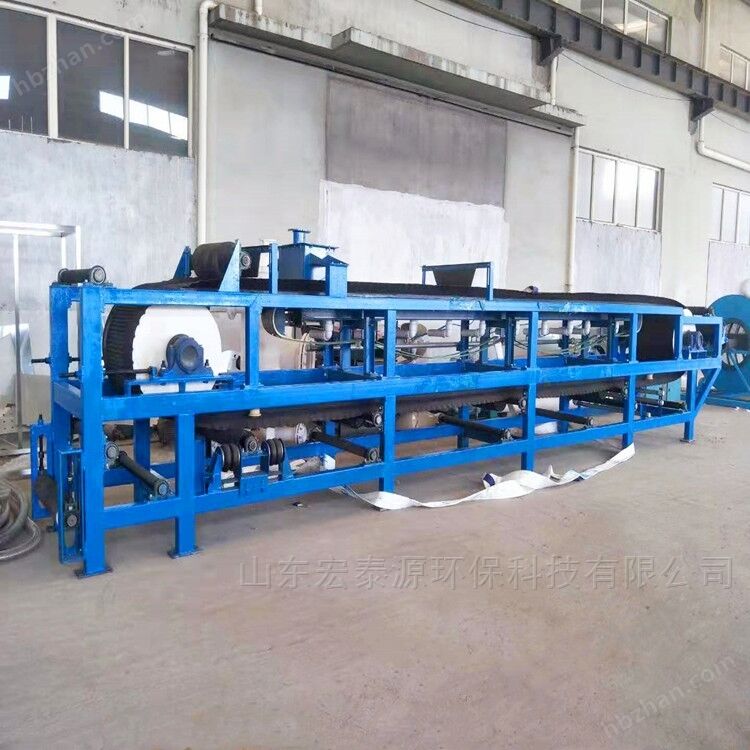


DU vacuum rubber belt filter
NegotiableUpdate on 03/07
- Model
- Nature of the Manufacturer
- Producers
- Product Category
- Place of Origin
Overview
DU vacuum rubber belt filter is a solid-liquid separation equipment driven by vacuum negative pressure, mainly used in filtration operations in metallurgy, mining, chemical industry, environmental protection and other fields, especially playing an important role in flue gas desulfurization gypsum dehydration (FGD). This equipment is suitable for large-scale industrial scenarios by continuously completing process operations such as feeding filtration, filter cake washing, suction drying, unloading, and filter cloth regeneration.
Product Details
Vacuum rubber belt filter is a solid-liquid separation equipment driven by vacuum negative pressure, mainly used in filtration operations in metallurgy, mining, chemical industry, environmental protection and other fields, especially playing an important role in flue gas desulfurization gypsum dehydration (FGD). This equipment is suitable for large-scale industrial scenarios by continuously completing process operations such as feeding filtration, filter cake washing, suction drying, unloading, and filter cloth regeneration.
1. Working principle of vacuum rubber belt filter machine
The annular belt of the rubber belt vacuum filter is driven by a motor to operate continuously. The belt and the vacuum slide are in contact through an annular friction belt to form a water seal, preventing damage to the vacuum environment. The main filtering medium of the rubber belt vacuum filter is filter cloth, and the slurry is evenly distributed on the filter cloth by the distributor.
After the vacuum chamber of the rubber belt vacuum filter is connected to the vacuum system, a vacuum filtration zone is formed on the annular rubber belt. Under the drive of vacuum and gravity, the filtrate passes through the filter cloth and enters the vacuum chamber through the rubber belt, while solid particles are intercepted by the filter cloth to form a filter cake. The circular rubber belt of the equipment will drive the filter cake to move through the washing and drying areas, and then remove the filter cake.
2. Performance characteristics of rubber belt vacuum filter machine
The rubber belt of the rubber belt vacuum filter uses the moisture in the slurry to form a water seal with the vacuum chamber during its movement. At the same time, the rubber belt vacuum filter utilizes the lubrication and cooling functions of sealing water as a lubricant and coolant, reducing wear on the annular rubber and related components.
The rubber belt vacuum filter is easy to operate and can run continuously. The filtration efficiency of the product is good, with a large processing capacity and production capacity among the belt vacuum filter series products. In addition, the rubber belt vacuum filter has good washing effect and can obtain higher quality filter cake.
product structure
The general design structure of the product mainly includes five parts: the belt and transmission mechanism of the vacuum belt filter, the vacuum box and support and friction device, the discharge washing and restoration support structure, various auxiliary devices, and the rigid frame for component installation. Under the auxiliary device of the vacuum belt filter, there are also structures such as feeding and cake removal devices for the filter.
process flow

common problem:
Q1: What could be the possible reason for the high water content in the filtered cake?
A1: There are three main core reasons. Firstly, the vacuum degree is insufficient, and it is necessary to check whether the vacuum pump is working properly and whether there is any air leakage in the pipeline; Secondly, if the selection of filter cloth is improper or blocked, the filter cloth should be replaced with a suitable material or the pores of the filter cloth should be cleaned; Thirdly, if the feeding amount is too large or the slurry concentration is uneven, it is necessary to adjust the feeding speed and ensure that the slurry is stirred evenly.
Q2: How to adjust the deviation of the filter cloth during equipment operation?
A2: Prioritize checking two key components. Firstly, adjust the filter cloth correction device and manually adjust the position of the correction roller to pull the deviated filter cloth back to the center; Next, check if the driving roller and the driven roller are parallel. If the roller body is tilted, loosen the fixing bolts to calibrate the levelness of the roller body, in order to avoid the deviation of the filter cloth due to uneven force.
Q3: How to choose filter cloth for different materials (such as sludge, ore slurry)?
A3: It needs to be matched according to the particle size and characteristics of the material. For fine particles and high viscosity materials (such as sludge), choose polyester or nylon filter cloth with moderate breathability and small pore size to prevent particle blockage; For coarse particles and low viscosity materials (such as ore slurry), polypropylene filter cloth with larger pore size can be used to improve filtration speed; Corrosive materials should be given priority to using acid and alkali resistant fluorinated filter cloth.


