-
E-mail
wfbslt@126.com
-
Phone
15105360218
-
Address
6th Floor, Deputy Building, Rundi Building, Dongfang Road, High tech Zone, Weifang City
Product Categories
Weifang Bishui Lantian Environmental Protection Equipment Co., Ltd


PCR laboratory sewage treatment equipment
NegotiableUpdate on 04/07
- Model
- Nature of the Manufacturer
- Producers
- Product Category
- Place of Origin
Overview
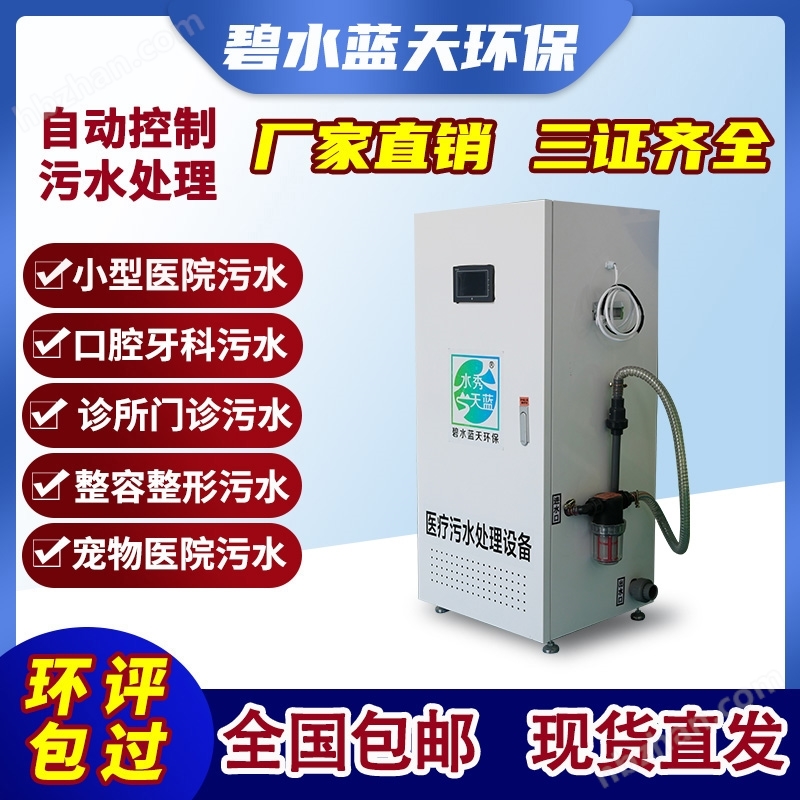
The laboratory sewage treatment equipment consists of a wastewater classification and collection unit, a wastewater regulation unit, a wastewater deep treatment unit, a sedimentation and separation unit, a physical treatment unit, a biological treatment unit, and a comprehensive wastewater purification unit. The comprehensive treatment of organic, inorganic, and biological wastewater generated in the laboratory can effectively remove COD, BOD, SS, chromaticity, and heavy metal ions from the wastewater through chemical pretreatment, chemical deep treatment, central sedimentation, high and low potential difference microelectrolysis technology, new packed bed photocatalytic reaction technology, disinfection and sterilization, multi-stage filtration and precipitation separation, and other treatment processes.
Product Details
Fundamentals of Laboratory Sewage Treatment Equipment Design
Source of laboratory wastewater: comprehensive laboratory wastewater generated from drugs, reagents, test solutions, instrument cleaning, etc;
2. Composition of laboratory comprehensive wastewater: inorganic, organic, biological wastewater, etc;
1) Inorganic wastewater: heavy metal ions, acid-base pH values, halogen ions, and other non-metallic ions, etc;
2) Organic wastewater: organic solvents, ammonia nitrogen, toluene, organic phosphorus pesticides, etc
3) Biological wastewater: viruses, chlamydia, mycoplasma, spirochetes, fungi, Brucella, anthrax bacteria, etc;
3. Process flow: Laboratory wastewater collection unit - Acid alkali neutralization unit - Laboratory organic wastewater treatment unit - Laboratory inorganic wastewater disinfection unit - Laboratory biological wastewater treatment unit - Terminal comprehensive deep treatment unit
Functional characteristics of laboratory sewage treatment equipment
1. Widely practical and adaptable to wastewater treatment in various laboratories;
2. Adopting multiple technologies for multi-stage treatment and purification of wastewater to meet discharge standards;
3. Central centralized control, high degree of automation, simple operation, fully automatic operation, no need for dedicated personnel to be on duty;
4. Automatic protection function for water leakage and electric leakage, high and low voltage automatic protection function, no wastewater protection function, and liquid level protection function for storage tanks;
5. Regular cleaning function: Regularly clean and rinse the parts that need to be cleaned and rinsed to extend the service life of the equipment;
6. Dynamic operation, digital LCD display of water quality indicators;
7. "One stop" integrated design, beautiful appearance, small footprint, fast processing speed, low operating cost, easy installation and movement, large processing capacity, good processing effect, low energy consumption, acid and alkali corrosion resistance, low noise, multiple safety protections, no leakage, environmentally friendly, truly achieving engineering equipment. No need to dig multiple treatment tanks, no secondary pollution such as waste residue, exhaust gas, and wastewater will be generated;
8. PLC intelligent control system, human-machine interface operating system, LCD liquid crystal display with Chinese language display, automatic detection of equipment electrical control system when turned on, fully automatic treatment of wastewater, and automatic calculation and proportional automatic dispensing of drugs according to the composition and concentration of different wastewater by the control system, making it more scientific and rational;
Installation of laboratory sewage treatment equipment
1. Forklifts or cranes are used for loading and unloading laboratory sewage treatment equipment.
2. The equipment should be placed horizontally on a concrete cushion layer, and the electrical control cabinet should be located away from corrosive gases, water, and easily damp areas to avoid damage to electrical components.
3. Connect the outlet pipe of the wastewater collection tank to the inlet pipe of the sewage treatment equipment and connect the outlet pipe;
Before connecting the wires, insulated rubber hoses should be used to protect the wires and fix them in appropriate positions to prevent leakage. The circuit should have safety devices, and live parts should be well grounded.
5. After installation, check again whether each component is fastened, whether the components are complete, whether the pipeline and circuit installation are correct, and whether the live setting is grounded. If there are no errors, the machine can be tested.
Debugging of laboratory sewage treatment equipment
1. The sewage treatment equipment has been proven to have no leakage or sinking displacement through static pressure testing, and finally accepted as qualified according to relevant regulations.
2. All equipment such as electrical appliances, machinery, and pipelines have been built and processedSingle machine test drive、joint test runNormal. Finally, the acceptance is qualified according to the relevant regulations (instructions).
3. According to future operational management needs, eligible users are required to conduct the most basic routine laboratory tests;
4. Investigation and mapping of basic data, including the diurnal variation of sewage flow rate, water quality (pH, water temperature, etc.) COD、 The technical parameters of various facilities and equipment, including nitrogen, phosphorus, toxic substances, and their changes.
5. Operators should be familiar with the pipeline layout and utility aspects of the entire system, understand the basic processes and control requirements of the system.
6. The user unit should establish complete safety operation procedures and assign dedicated personnel to maintain the operation;